Kari Christine Tauring (born July 4, 1966) is an American folk musician, author, and teacher. She sings and writes Nordic folk music of her familial Norwegian heritage. Her career began in the early 1990s in Rose Absolute, a duo with vocalist Gina Sauer, while her first solo studio album, Faith in Me, was released in 1998. Tauring has released five albums, and an extended play.
About Kari Tauring
http://karitauring.com
Kari is a working völva, living in Minneapolis, Minnesota and traveling widely with workshops and performances. She received a Minnesota State Arts Board Folk and Traditional Arts grant to weave together the runes, stav and ancient dances with the Immigrant Era song and dance traditions preserved in Minnesota. She is the author of The Runes: A Human Journey (2007) and Völva Stav Manual (2010) are available at lulu.com. Her recordings, "Yuletide Celebration" (1999), "Völva Songs" (2008), and "Kari Tauring and Huldre Live at the Capri" (2009) can be found through her website and her newest recording, "Nykken and Bear" (2013), received four broomsticks in the last issue of Witches and Pagans Magazine. She has undergraduate degrees in Philosophy and English a Master of Arts in education and was ordained through the Church of Spiritual Humanism. She is featured in a number of Youtube videos and podcasts and teaches in Minneapolis and abroad.
A Glimpse into the Northern Traditions through the Eyes of a Layman:
Embracing the Return of the völva: A Stroll along the Path of Northern Traditions with North American völva Kari Tauring
Germany, Denmark, Sweden, Norway and Iceland make up the old European North. "Nordic" can also include Finland and the Baltic. Viking adventurers came upon the northeastern coast of North America. They referred to the land they had found as rich and beautiful, naming it Vinland. (Erik the Red's Saga circa 13th Century AD). During the 1800's AD, another wave of Northern European immigrants brought with them their culture in the form of customs, arts, lifestyle, beliefs, and spirituality. 800,000 Norwegian immigrants amassed in Minnesota between 1860 and 1910. Similar numbers from Germany, Denmark, Sweden, Iceland and Finland populate Kari Tauring's home-state of Minnesota.
Tauring, a Nordic roots artist and völva, connects the ancient, the immigrant, and the modern in Nordic culture with her stories, songs, and dances that span the ages. A musician and scholar of over two decades, she brings deep knowledge and artistry to her presentations with the humor of one whose people shaped the face of the Norwegian-land in Minnesota and Wisconsin.
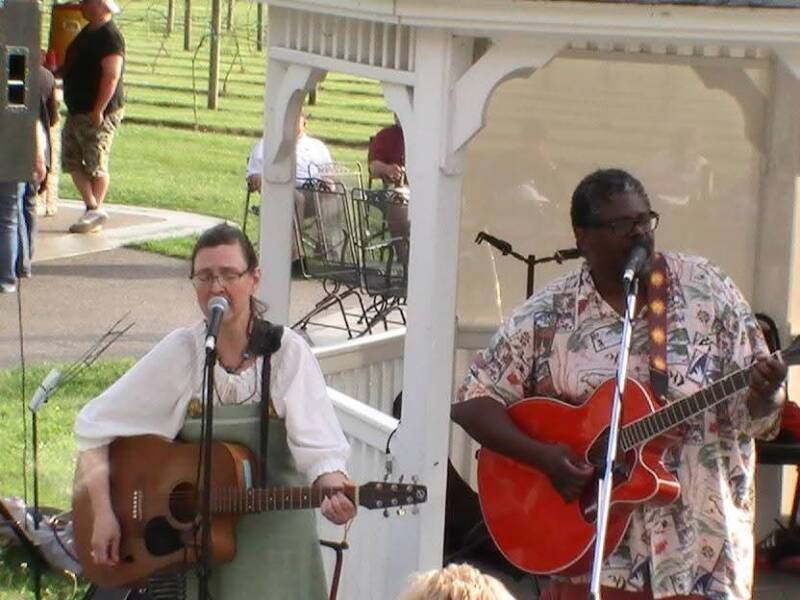
Along with her education programs and books, Kari’s skill as a performer and Nordic roots musician (with several recordings available) is well established in the Midwest and beyond. In live performance, Kari shares her love of being Minnesotan – “half Norwegian and six other things” – through personal stories, humor, and a keen understanding of her own deep roots.
Völva, staff carrying woman in Old Norse (plural volur, was the traveling culture bearer – as preserved in graves, poetry and folksongs – of Scandinavia. Kari is a living time-line, teaching connections between the ancient and modern in Nordic culture.
Tauring, a Nordic roots artist and völva, connects the ancient, the immigrant, and the modern in Nordic culture with her stories, songs, and dances that span the ages. A musician and scholar of over two decades, she brings deep knowledge and artistry to her presentations with the humor of one whose people shaped the face of the Norwegian-land in Minnesota and Wisconsin.
Along with her education programs and books, Kari’s skill as a performer and Nordic roots musician (with several recordings available) is well established in the Midwest and beyond. In live performance, Kari shares her love of being Minnesotan – “half Norwegian and six other things” – through personal stories, humor, and a keen understanding of her own deep roots.
From 2010 - 2014, Kari has tackled the question about what being a völva means in a modern context. With the support of Minnesota, Michigan and Kansas leadership, she has represented this "office" yearly at Midwest Thing. (http://midwesttribes.com/). A "Thing" is an Old Norse word for the intentional gathering of people to discuss the laws, issues, and solutions for the greater community. The word is still used in Scandinavia for their parliament. Representatives of kindreds (groups oathed to one another for the perpetuation of Heathen core cultural values) and other large groups have been gathering at Camp Gaea near Lawrence, Kansas to participate in the Midwest Thing since 2009.
In March 2012, I was fortunate to be introduced to Ms Tauring by Hrefna Wolfwalker of Hawk’s Bayou and Raven’s Nest kindred in South Mississippi. Ms Tauring had agreed to come from her home in Minneapolis, Minnesota to be a part of Seiðr Studies and Northern Magicks and Mysteries Weekend; an event hosted by Hrefna’s Kindred. When she arrived, I saw a petit woman with an unassuming air. Upon meeting her face to face; I found her to have a glow about her that gave her the presence of the völva she was and I began to understand at that moment, what a gift I would be given in the words she had come to speak.
In the weeks preceding and the days that followed the event, I interviewed Ms Tauring, under my Craft name of Sorcha Feilnar, via e-mail and at the event itself. The following is the result of those interviews.
Völva, staff carrying woman in Old Norse (plural volur, was the traveling culture bearer – as preserved in graves, poetry and folksongs – of Scandinavia. Kari is a living time-line, teaching connections between the ancient and modern in Nordic culture.
Updated Questions for 2014:
I do have a question I have wondered about, especially after having met you here in our little region. As you travel the world, what differences and similarities have you discovered among the people who follow the Northern Traditions? Also, how do they vary from the practices of the people in the home countries? How are they similar? As an American Volva, what have you learned in your travels? I'm always interested in cultural practices. I'm kind of nerdy that way.
Original Interview Questions
SF: How old were you when you began your path?
KT: When I was three I experienced my first spiritual quandary. While spinning round and round on my bottom I exclaimed, “But mommy, who was God's mother?” It was the first of many questions and not the last time my mother worried after my inquisitive soul. At age seven I confessed to my grandmother that I didn't like to pray in church because praying always made me feel like singing and dancing and it was very hard to keep still. My grandmother assured me that I could do that sort of praying in nature. Every time Jesus had a very important prayer he was on the mountain or in the garden or the desert. So I began to pray in nature and nature answered back.
At thirteen years old I had my first contact with a deity that was outside of my Lutheran upbringing and the nature energies of my Midwestern experience. When I was sitting at the top of the pyramid of the sun outside of Mexico City, I got in my nature praying pose. I felt the sun on my face and closed my eyes. Suddenly it felt like a heavy weight was on my chest and there was a vibration so different. I tried to open my eyes but could only see a smiling god sitting on me. I prayed to Jesus to help me as I was really scared. He came from my heart space and it was as though the two gods were doing a dance. Finally this other god receded. Later, in a tourist shop, I picked up a postcard of Chac Mool, the face I had seen belonged to him and he was in the same praying pose I was in when he came to me. It was quite unnerving to think he was the recipient of the "hearts of human sacrifices" as the post card read.
I was lucky to have a very intelligent youth pastor to talk to when I got home. She said to me, “the first commandment isn't that there are no other gods but that you shouldn't have any other gods before Yahweh.” It was a frightening and liberating idea that there were many other gods. It was at that moment I knew I would dedicate my life to finding them and figuring out how they fit into my world view. Of course relationships with divine mostly change your world view rather than fit it! When in doubt, I could always check back in with my heart's Jesus.
Incidentally, Some thirty years after this experience, I was presenting Norse tradition as part of a "Midwest Shamanic Gathering" and a beautiful Aztec teacher showed me the real Chac Mool. "Not the one described by the Christians but the god of heart chakra yoga," as she taught me.
Martial Arts was a bedrock for my study of energy and body connection to the natural world. It gave me a grid work through which to focus my nature prayers. At around age 16 I began the process of aligning with the moon cycles and practicing Goddess centered spirituality and ritual. Mother Mary was the gateway to the Great Goddess. At twenty I wrote a pagan hand book for private use. I was being asked to start up a coven and while I have always been a spiritual leader and teacher, I don't want a school or church.
As an undergraduate at St. Thomas (1988) I studied with some Lakota women, doing sweats and medicine wheels. I further explored energy work, past life regression, re-birthing, and Reiki. In a linguistics class, the late Dr. Luann Dummer introduced me to the rune alphabet. The runes and Norse mythology changed my identity. Growing up in an extended Norwegian-American maternal enclave in Minnesota and Wisconsin, I never thought to look deeper into my Norwegian root. The runes plunged my entire being into the fjord bottom. Combining Nordic spiritual traditions with my music and teaching developed over the decades and it was in 2003 that I understood myself to be on the path of staff carrier.
SF: Were you surprised by anything you learned about your heritage?
KT: Of course, I was surprised that I wasn't German! I found the story of my Latvian heritage very compelling. My great grandmother Tauring was pregnant with twins when they left the post of Baron of Riga to escape political trouble. She lost the twins at sea on the way here and lost other children besides. She was very sad, angry, and placed that burden on my paternal grandfather who took it out on his own children, my father and his siblings through alcoholism and abuse. This was one of the first aspects of inherited cultural grief I endeavored to heal in my heritage and I must say, it has been truly wonderful.
SF: Was information about your ancestry readily available to you through your family; or did you find it necessary to research your heritage?
KT: As I mentioned, I grew up in an extended Norwegian-American family on my mother's side. My grandmother and her sister had been back to Norway to visit her relatives and those of her husband. My grandfather died before I was born but he was a farmer of the old school and the well finder throughout Polk County, Wisconsin. My mother, aunts, cousins and sisters had been to visit the relatives in Norway too. I admit to feeling a little “outsider” about it because, unlike my three sisters, I had brown hair and eyes. I also didn't like lefse, the Norwegian potato flat bread that identifies Norwegian-Americans in the Midwest.The runes took my root to before the arrival of the potato in Norway!
We grew up thinking we were half Norwegian and half German but in Junior High I did a family tree project. Since my Norwegian side was well known into the 1500's I thought I would do my father's side, the Germans. I found out that we are not German at all! My last name, Tauring, is Latvian for butterfly. My grandfather was Latvian and Luxembourgian. My grandmother was Scotts-Irish, French-Canadian, English and as she said, “some kind of Indian.” This heritage made sense to me as the Celtic influence showed up in my fiddle and dance playing early on and the Native American connection had a tangible thread in early spiritual experiences.
SF: What prompted you to explore the idea of Cultural Grief?
KT: As a child of an Adult Child of an Alcoholic (ACOA), I began to explore “family of origin” dysfunctions in high school (as soon as I found out there were such thing as counselors). If I had grown up with the language and understanding of öorlog, perhaps the process would have been easier. The idea of “original sin” does not explain the inheritance of dysfunctional traits or how that concept plays out in daily life. The presence of a “satanic figure” does explain how one woman's grief and pain in 1890 could translate into a drinking problem for her descendent in 1948. But “family of origin” dysfunction in an ACOA context explains it fully. And this, for me, is part of the definition of öorlog. Those thoughts, feelings, actions, cultural traumas, beliefs about self and god that we inherit from our ancestors are as important as the genetic material. In fact, the genetic material is malleable and changes based on the chemicals we ingest and the thoughts we have. So really, it is the emotional material before the genetic material that actually matters in healing öorlog, in overcoming inherited cultural grief. Even modern science is catching up with this notion in the study of epi-genetics.
When I began working with the runes they had the affect of unlocking what I then called “tribal karma” which included ancestor memories. The ancient Norwegian in me began to speak. Of course the mother's lineage is the mitochondrial lineage, mother to mother to mother. It is perhaps the most compelling of all, the genetic tap root back to the first mother in the world.
I began calling this phenomenon inherited cultural grief in 2007. Jewish holocaust survivors mostly refer to it as historical unresolved trauma. Native Americans who work on this issue most often refer to it as Ancestor Grief. The concept that we carry the traumas of our ancestors is prevalent in the Norse concept of öorlog.
SF: Did you feel a rift in your inner being because of your blended heritage or were you at ease with it right away?
KT: Interesting question. I felt a “discombobulation” about myself before I understood that I was more than my immigrant era Norwegian-American identity. Finding out about my Celtic roots made sense of my early fascination with Celtic music, dance, and myths. My love of amber, horses, and honey comes directly from my Latvian heritage. More things make sense when you know more about who you are.
SF: Did you always feel a natural pull to the belief systems of your ancestors?
KT: Ancestor honoring and nature spirituality are the basis of Norse tradition, all folk cultures actually. Though I was raised in a Lutheran household, I was also raised in a household that held core folk cultural values. So the idea of ancestor honoring and nature spirituality were in me from the get go but I didn't have the deep language for them or the ancient understanding of them. I was just so happy to find these concepts in Old Norse so I didn't have to borrow language from other cultures to express these core folk spiritual values.
SF: In what ways do you feel healing Cultural Grief can improve a person’s well being and happiness?
KT: Since it begins with healing family of origin dysfunctions, the pay off in personal relationships, well being and happiness is immediate. Continuing on from there, healing deep cultural griefs puts us in compassion with others who have experienced deep cultural grief. Healing it in ourselves helps to heal it in the world at large. A culture doesn't become “the oppressor” without having experienced oppression. It is key that European-Americans look at their own griefs and hurts in order to stop perpetuating oppressive systems. Moreover, the deeper we go the more we find we are related to one another as humans. Healing the very first hurts in humanity starts by healing in ourselves. This world surely needs deep healing.
SF: It seems to me what you do and the person you are is the most natural thing in the world for you. With that in the mind, are you ever surprised at the respect and reputation you have received in your own Tradition, as well as those outside of the Northern Traditions?
KT: Thank you. It does feel very natural to be who I am and to do this work. I sometimes forget that I have been working on this steadily and consciously for thirty years and that it was not always natural feeling or easy. It's important for me to share my journey as well as the results of the daily diligence to live honestly. Good scholarship and lengthy contemplation before declaration is another Nordic trait that my family valued deeply. It is what earns the respect of others.
It is interesting that in the last census the top two hobbies in America are gardening and genealogy. I think there is a deep longing for European-Americans to find the pathway back to these core folk cultural values of nature and ancestry. They are attracted to pathways that include authentic language, song, and dance from the folk culture as well as good scholarship.
SF: What kind of study and practice is involved in becoming völva through völva stav?
KT: Völva Stav is a methodology and practice of aligning with the world tree that I have developed over the past decade. I did not intend for it to become a way to "train völur (plural)." It is a mind, body, spirit practice and alignment that is authentically Nordic. I have made this method of stav and tein (staff and wand) techniques for rhythm and rune-chant and inter-dimensional alignment with the world tree available in a free manual and youtube videos and teach it widely in Minnesota. It does not train anyone to "be a völva" per se. Really, it is your community that calls you such.
Völva stav increases physical stamina. In inter-dimensional world tree alignment, we hold the vibration of all the worlds, our ancestors and other entities. We learn to vibrate our bodies to nature. This is why my coursework also teaches good boundary setting skills, clear, honest, respectful and immediate communication on every level, and impeccability of word.
As in the description of Heidr from the Voluspa Edda, a völva is expected to be a wise woman in the culture. For me that means knowing the stories, songs, dances, rituals and languages of my culture. I am constantly reading and researching, teaching and presenting. I think of a völva as a theologian, a vessel of the lore, wise in the ways of Norse metaphysics. Not that all völur must be professional in all of these things, but they must be wise in them and able to nurture these things in the young people of the culture they serve. The definition of völva in Minnesota heathenry is simply a spåkjærring (prophet woman or wise speaker) and seidr bearer (one who attains a state of seidr and works within the nine worlds for healing etc.) who is un-oathed to a specific kindred or group and is thus available to all.
SF: What advice can you give to others who would like to begin learning the Northern Traditions?
KT: Start by learning the runes. The Elder Futhark is the oldest record we have of our ancestors mind set, values, and perceptions of the world. The runes teach us the myths and stories. The rune symbols unlock deep memories, ancestor memories. They are the language of our Northern souls. Read the Eddas and Sagas. Then look to the immigrant traditions in Northern heritage. The songs, dances, languages, food, and celebrations of folk heritage are encoded ancient messages from the deepest ancestors. Find a cultural preservation group and visit with the elders. Find out their stories and songs. Learn the language. This is what keeps the soul of culture alive. This is the difference between a culturally specific spiritual practice and a reconstruction of a religion.
SF: How does your foundation in the beliefs and practices, of the Northern Traditions, translate into your everyday life?
KT: I spend many hours a day researching, writing and rehearsing new songs, dances, and stories. I have taken several pilgrimages to my ancestral farms in Norway and continue to strengthen the ties that bind me to that land and my relations there. I notice runes every day, in the trees and sidewalk cracks where I read messages from my ancestors, nature spirits and the gods. I am in constant conversation with the natural world. There has really never been a different way to be in my life but Nordic. Teaching, leading ceremony, performing and recording the songs, writing books and articles, and traveling to share my heritage is my life's work and sole income.
SF: I understand that many Northern Tradition groups are closed groups; while others are open to anyone who wishes to know more. What are your views on other traditions or paths participating in the practices of the Northern Traditions?
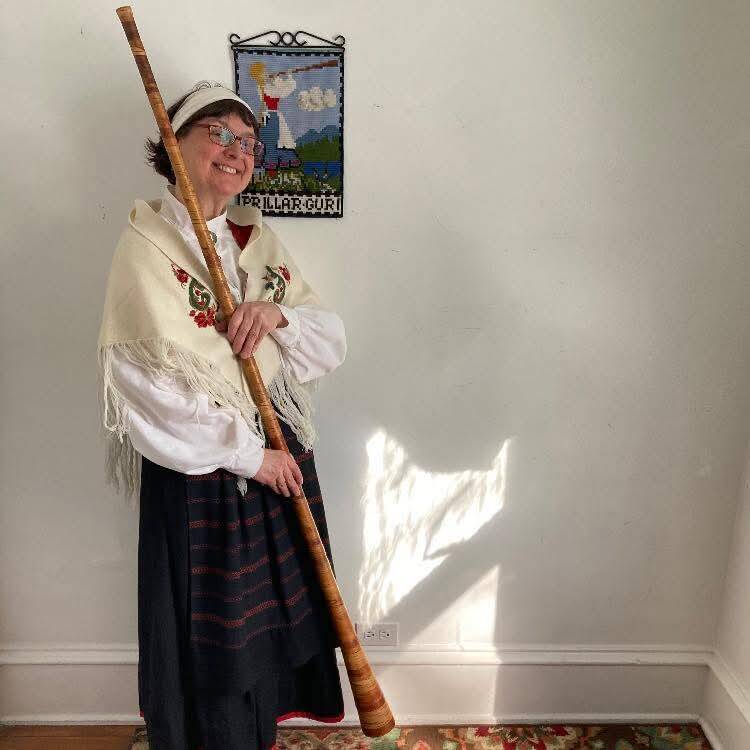
Kari playing a beautiful goat horn.
KT: In Minnesota, it's hard to find anyone who isn't influenced by Northern European immigrant traditions. Many Native and African Americans in Minnesota also have Northern European heritage. Some have come to my classes to find out more about that aspect of themselves and find that the deep folk traditions of their Nordic side often compliment and echo parts of their other folk traditions. Völva Stav is my personal expression of Nordic folkway and a spiritual practice, not a religion. So anyone can begin the practice and most people find it echoes other core culture values.
I continue to benefit from the scholarly work being done by many fine Norse scholars and spiritual practitioners. Reading about other people's work and experiencing it points out differences and similarities. Some pathways are influenced by non-Nordic/Germanic pracitces such as Core Shamanism, Wicca, or even Voodoo. These pathways do not feel indigenous to my family and culture of origin. There are huge differences between German paganism/heathenry, Anglo-Saxon paganism/heathenry, and Norwegian paganism/heathenry. Heck, there are huge differences between Eastern and Western Norwegian language, culture, and spiritual expression.
There is a trend in National heathen organizations to generalize Nordic/Germanic culture. I get a little unnerved when I hear people who I know I am not related to say "our ancestors would have..." or "our gods..." I want to hear more people put their Nordic beliefs and understandings in the first person - "my ancestors did such and such..." And "in my experience of Odin..." rather than make great claims to some universal truth. That's very religion-ish and patriarchal. Spiritual folkways are connected to specific cultural and family of origin traditions. I would love everyone to explore these things in their own lives and in their own heritages.
SF: I am fortunate to have been invited to a several Northern Tradition functions. Being someone of a different Path, I understand the trust that such an invitation bestows; I was quite humbled by the fact. I found myself swept up in every aspect of each occasion. I was especially moved by the commitments to family, kindred, and the ancestors. I especially have respect for how the dead are treated. What, in your eyes, is the most profound principle of your Path?
KT: The principal of Ansuz is profound - the rune of the mouth and spoken word, dedication to impeccability of word. Everything we speak, however casual or “jokingly” we say it, becomes a layer in our öorlog. The more deeply we understand this, the quieter we become, and the better listeners we become. This is the most important thing, that our words are clear, honest, and respectful. The second most important thing is the concept of Skuld. We honor the past as Urd and the present moment as Verthandi, but Skuld's name means “that which by necessity ought to become.” Necessity is a deeply important principal in Norse tradition because we ought not say or do anything unless there is need. So these two principals tie in together. These were the principals that my Norwegian grandparents lived by, though they didn't intellectualize these ancient principals.
SF: Do you have any new writings planned for the future?
KT: I am almost finished with the second edition of my rune book, "The Runes: A Human Journey" (2007). The updates to the chapters will first show up on the iPhone/iPad Application by the same name. Many people would like to see me flesh out the Völva Stav Manual (each small section could be a major chapter). Still others have been asking for some on-line coursework to be made available. It is all a process!
I'm working on curriculum in Nordic Movement (walking, dancing, skiing) with Norwegian traditional dancers and skiers this year. It is my hope to share this curriculum with the "new immigrant" cultures in Minnesota (Somalian, Latino, and Hmong). Living in the Northlands where we walk around on ice for half the year really changes you, how your body moves. It is all part of Nordic Movement and described in the motion of stav. These environmental conditions put "being Nordic" beyond any ethnicity or genetics. It's about survival as a Northerner!
Finally, I am writing and speaking about my visits to my ancestral lands in Norway. All of my mother's mothers come from one mountain in the Sognefjord. It is a UNESCO World Heritage site. The archeology suggests that the same ekte geitost (brown caramelized goat cheese) has been made in that area in an unbroken tradition since the Bronze Age. That's a 4,000 year old tradition! That's what I call soul food.
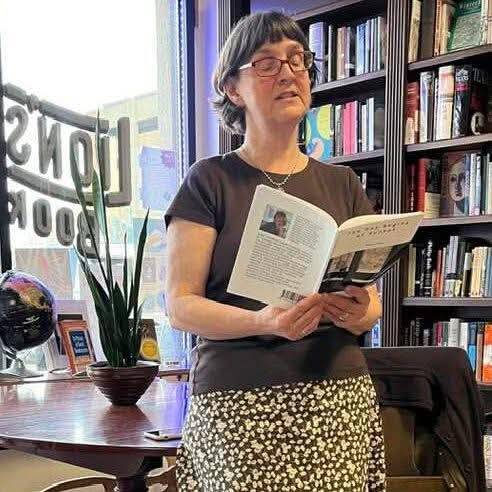
Kari reading one of her books to an audience at a bookstore.
SF: Because of your workshop and your writings, I understand historically; a völva was a bit apart from the traditional social norms of women in the Norse Clan society structure.
KT: From what we know, yes. These women were “un-affiliated” and lived utgard (outside of the farm or community boundaries). This would give them a “non-partisan” view of the wyrd of any community they visited. But I do want to stress that the Nordic lands were tribal and diverse. The idea that there was a unified orthodoxy among staff carriers and the people they served is a modern notion. Just as there was no unified "our gods" or "our ancestors" - every family, clan, and village had their own unique ways of understanding and being in the world. The skill set of each völva would have differed, one reason they were described as part of a collection of women. There is mention and evidence of schools of völur who trained in various arts. Thorbjorg, from Erik the Red's Saga, was the last of nine sisters who were all Spåqueens, prophets. There is evidence of a matrilineal heritage among völur in other parts of the Eddas and Sagas as well.
SF: A Völva may not have had a husband or “protector”; yet she traveled great distances, sometimes in the accompaniment of students?
KT: On the one hand she traveled great distances, but Europe is so different in “distances” than the US. It's only 677 miles from Oslo to Berlin, whereas it's almost 1200 miles from Minneapolis, Minnesota to Biloxi, Mississippi! In Thorbjorg's story they sent a man out to meet her on the road. It seems likely that a warrior/farmer from the last village would accompany her part way and someone from the next village would meet her and bring her in as she was coming by invitation and as part of a regularly scheduled yearly journey. Völur were also known to “set up shop” in public houses or at thingtide gathers and festivals to offer their prophesy work.
In pre-Roman/pre-Christian times, she was safe to travel because she was revered, she was a visitor (the law of guest friendliness is still observed in Nordic homes) and she was perhaps a bit scary because she had a relationship with nature entities and creatures from the nine worlds. Her favor was most often sought and her anger was commonly feared.
SF: Was she summoned in times of crisis or distress? Did she carried news of the villages she visited with her as she traveled?
KT: Yes to all. One of a particular skill may have been summoned in a crisis such as war. Often a völva’s visit was part of her “yearly rounds” as seen in Thorbjorg's story. They would carry news that could affect a whole region such as new raiding parties that have appeared on the scene, diseases, problems with farming or fishing, or changes in family structures with political implications. Sometimes I describe them as the wandering Farmer's Almanac.
They were not vowed to use “only for good" or "in light and love" as we think of spiritual leaders today. There were some who were more skilled in battle magic, some who were healers, and some whose prophecy was sought out. Some had the ability to direct weather, commune and command animals, to curse as well as heal, and the general oddity/novelty of the utgard woman gave them much mystique.
SF: I understand the völva was held in very high regard and respected, as she was wise in lore and history. Also, her work as a healer and ability read the runes (or is interpret the more correct term) gave her high standing in the social culture of the time.
KT: Interpreting runes and using them in charms, cures, and for other magic was part of their training. This gave them a level of literacy that set them apart even from many chieftains. It has been suggested that as patriarchy and Christianity began to hold sway in the upper classes and the status of women declined it became dangerous for völur to travel. They often sought refuge with Heathen chieftains which caused tremendous strain on women's relationships. Instead of having the honor of hosting and learning from a visiting völva, a cheiftain's wife might find herself politically out-ranked by one living under her roof. I can't help but feel this may be part of the roots of the dysfunctional "church basement lady" syndrome that is very prevalent in Scandinavian-American culture.
SF: Is it accurate to say because she performed wyrd energy and could be a prophet, as well as all her other skills, she was revered?
KT: In my understanding, völur use a seidr state to perceive the wyrd web of people, family units, communities, time lines, earth lay lines...and then could make predictions and shift the direction of the wyrd with magic incantations and rune songs. In a seidr state they can communicate with nature wights, animals, gods, and ancestors long passed and work deals with them to affect the lives and fortunes of the living. They can also use this skill to curse, heal, change the direction of war, and play with people's minds. The accuracy and consistency of these skills gave a völva respect and reverence as well as wealth. As their skills were tested, reputations increased along with income. They were well paid for their services.
SF: Am I correct in understanding that she would often settle disputes as well?
KT: There are a few instances where a law speaker could not make a decision from the information available or because his allegiance was too strong on one side or the other. At such an impasse, a völva or vitki (male staff carrier) would “go under the cloak” and "uttisetti" (sit out). This is a practice maintained by seidr bearers in the US and Scandinavia today. One literally pulls a blanket or cloak hood over themselves and sits out in the elements until they have a revelation.
The most famous of these incidents was 1000 years ago in Iceland when the conflict to call the nation Christian or remain Heathen came to a head. Þorgeir Þorkelsson Ljósvetningagoði (gothi indicates he was the priest or god-person of the farm Ljosvatni), went “under the cloak” to consider the best resolution for the whole of the island. He declared that they would accept Christianity for 1000 years; but that the local religion could be practiced privately without threat of persecution. Interestingly, Iceland is at the end of that 1000 years. They have publicly acknowledged Asatru/Norse paganism as a legal religion. Most modern Icelanders understand their deep heathen heritage and families have maintained connections to land spirits and ancestors just as they had in the past.
SF: Would you say at this point in the Norse culture, a völva would have been so respected as to be free to travel unhindered by clan differences, bandits, or men in general?
KT: In the early Iron Age, until the early Viking Age, this appears to be the case. There are no reports of rape or other molestation. With a völva’s ability to curse, I hardly think it prudent. Also, they were generally older women who were either done with family commitments or never had any. Additionally, they were terribly well off and could certainly have paid for an escort if traveling in unfriendly territory. Also, remember, this was a militia society. Everyone; men, women, and children, were expected to be able to fight and defend themselves. The old laws make that clear.
SF: I read where later, as the society began to take a patriarchal view, her role changed significantly. Could you tell me a bit more about this?
KT: Everywhere that Christianity and patriarchy grew, wise women, single women, and old women were being called witches. It became unsafe for women in general all throughout Europe. Many völvas sought the patronage of warlords and chieftains. This removed her non-partisan view which was, I think, damaging. Worse though, it caused tremendous strain within the compound as she would have out-ranked the chieftains wife who was generally gifted in some of the ways of the völva such as spå, healing, leech craft and/or in war council.
I think the stress of this competitive and unbalanced system is part of the inherited cultural grief we need to heal among European American women and women in general. This rivalry between powerful women for what crumbs of respect they could attain has been the downfall of humanity in my opinion. Better for society that strong women should support and cooperate with one another. Cooperative women in solidarity of purpose is a real threat to patriarchy.
Some völur did not seek patronage but rather hid themselves in remote natural areas and continued their work on a smaller scale. These women gained a different reputation among both Heathens and Christians as witches or sometimes doctors. They were called trollwives in Scandinavia and spåkjærring or prophesy lady was a title carried even into the immigrant communities of Norwegian-Americans. The word volva in modern Norwegian has come to mean, as one woman put it, "..lady parts...and not in a good way." Even kjærring (meaning honored lady and wife) is being used in modern Norway in place of "bitch." This modern meaning has not reached Midwestern Norwegian-America and we find it shocking, but not surprising, that words honoring women should take on negative meanings.
SF: In her new role in society, was she an advisor to the Warlord for whom she served? Or did she continue in her traditional role, but only within the Warlord’s household and clan?
KT: Her role changed greatly as she adopted the main job as council to the king who protected her. As Christianity took hold, vitkis remained in these positions adopting the staff and robe of bishops within the political church structure. The völvas were driven out and generally had to eek out a living as midwives and charm sellers on the outskirts of towns or as traveling fortune tellers...but this became more rare as the church banned them from the public houses.
SF: Was it mostly because of a change in the views towards women in general, or was it also because the need for her skills was replaced by other things?
KT: All together it was the change in the status of women in general that was the downfall of the völva. Her role as healer never changed. Even into the immigrant era (1860 – 1900 ACE), healing was women's work, despite the laws attacking and prohibiting the practice of women who were jordmors (midwives) and gammledoktors (old time doctors). In Norway, when pastors were sent to outlying districts, it was assumed that the pastor's wife would be doing the doctoring. There are many accounts of pastor's wives ordering doctoring books and trying to step up to the plate for this role and letters home expressing the sheer terror of being expected to do a job for which they were wholly unprepared.
SF: Did her male counterparts, vitkis undergo the same social changes?
KT: As mentioned, vitkis were able to step into roles as advisors, but eventually it was convert or be exiled (or worse). Conversion was necessary to maintain commerce and politics as Christians would only trade or do other business with other Christians. Christianity provided spiritually powerful men a variety of expressions in the priesthoods and monasteries along with political power.
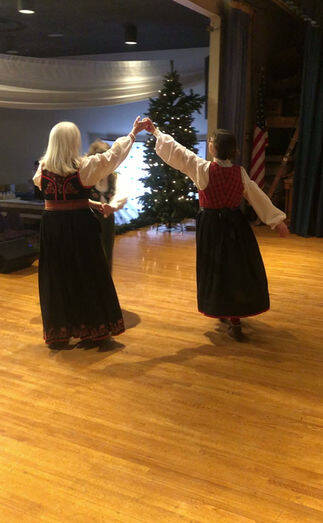
Leading Song Circle Dance in Green Bay, WI.
.
SF: Other than the convenience of modern technology and the means and need for travel, how has the role of the modern day völva changed?
KT: This is a most excellent question. If the völva is there to serve the community, then she would not exist if the community of Heathens were not getting large enough to support some. The process of defining völva in modern terms is on-going. I view it as important that a völva be able to help heal and bridge the fractures between Christians and Heathens within individual öorlog and in the community at large.
Most modern kindreds have talented gothi and gythia, law speakers, scholars and skalds, spae men and women, and rune readers. If I have a role, it is to support them and offer new tools such as ceremonial song and dance, modern modalities of healing family of origin issues, and examples from other communities throughout the Midwest, Norway and Sweden where I have visited and studied with others on this path.
SF: The völva, in her traditional role, was the keeper of knowledge and lore. After your workshop I can see that aspect of the völva’s work is alive and well. Has the role of the völva become more in line with that of a teacher in these modern times; or is she still viewed as the mystic and powerful woman the völva once was to the ancient Norse?
KT: First of all, thank you. Study of the lore is a continual process, education and teaching are a huge part of my life. Heathen communities are still defining roles within kindred structures so I think it may even be premature to try and define the role of völva. For me, the “unaffiliated” part is very important. I place huge emphasis on family of origin öorlog healing. Mending the broken warp threads of the European American tapestry is essential for the health and healing of the whole world. The thing that defines a modern völva for me and for my students is dedication to high functioning life skills and impeccability of word, becoming healed healers. Only through the diligence of this process can we be trusted to read the wyrd of the European American öorlog without emotional attachment or personal judgment. To heal our wyrd, make amends (pay shild) for wrongs done by our culture to others, and to create a strong tap root for healing ourselves and others is the basis of my work and at the core of my teachings.
______________________________________________________________
I learned much from my conversations with Kari. The changing world of the ancient völva was the reality for the women of many cultures at that time; and has stayed a part of many women’s realities into this day. The world lost something beautiful and essential with the caging of womankind’s abilities, pride, gifts, contributions, and sense of self.
Women are beginning to regain the essence stolen from them so long ago. As a whole, we are blessed to have the Wisdom Keepers like Kari Tauring to remind us of what we once were and could be again. So very far have we have looked away from our associations with the past. In this fast changing world, the lessons Kari imparts are not only for the people of the Northern Traditions; but can be utilized by the human animal as a whole. Discovery of who we are, healing within, the recovery of ancient wisdoms, and re-linking with the land will bring us to ourselves and in turn, to each other.
Special thanks to Hrefna Wolfwalker (Hawk Bayou Kindred) and Brigiða Ásvinr (Hrafn Bjorn Kindred). Without your patient guidance, explanations, and translations I could not have completed this interview.
Teaching/Demonstrating in Minot North Dakota