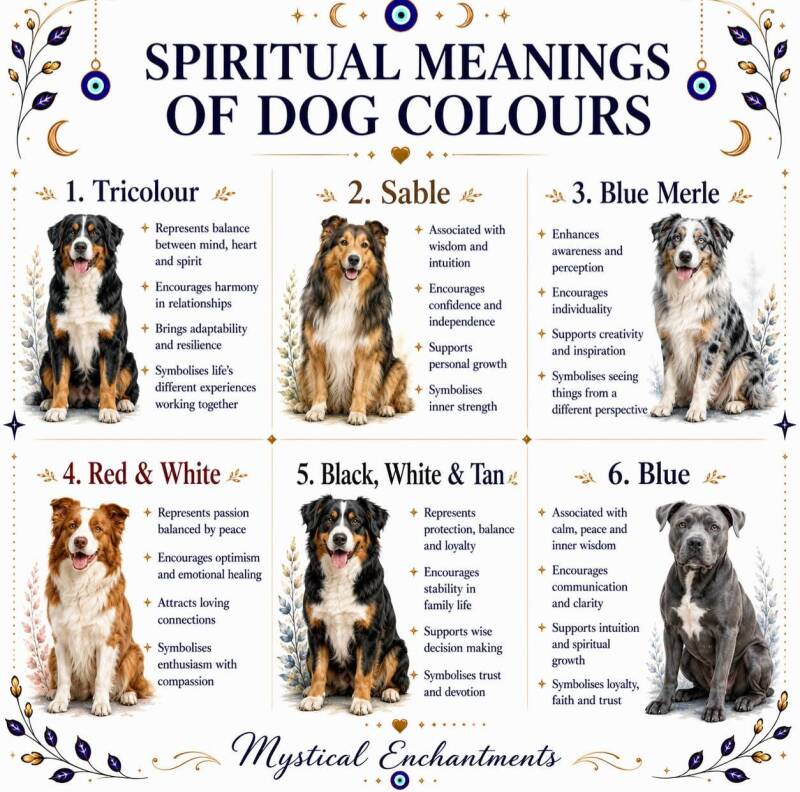
When considering the wellbeing of pets in the context of "magickal care," it is important to focus on practices that prioritize their physical health, emotional welfare, and environmental enrichment, while infusing symbolic or ritual elements that are harmless and supportive. Here is a structured and practical approach:
- Foundational Health and Safety
- Ensure pets receive regular veterinary checkups, vaccinations, and parasite prevention.
- Provide balanced nutrition, clean water, and safe shelter. Magickal intent should never replace these basics.
- Maintain a safe environment, free from toxins or sharp objects.
- Energetic and Environmental Harmony
- Create calm, comfortable spaces for rest. Some caretakers use crystals (e.g., rose quartz for calmness) or soothing sounds to create positive energy, ensuring these items are placed safely and out of reach.
- Use herbal aromatherapy carefully (lavender, chamomile) in diffusers, but always check that the plant is non-toxic to the species.
- Ritualized Bonding and Intention
- Engage in mindful interaction, such as petting, grooming, or playtime, while setting intentions for their health and happiness.
- Simple rituals like lighting a candle safely nearby and mentally sending loving energy can enhance your bond without affecting their safety.
- Keep ritual objects symbolic and non-ingestible; pets should never chew or ingest herbs, oils, or crystals.
- Behavioral and Emotional Support
- Address stress and separation anxiety using methods like enrichment toys, socialization, and predictable routines.
- Positive reinforcement (treats, praise) is more effective than symbolic punishment.
- Ethical Magick Practices
- Avoid any practice that aims to control a pet or cause discomfort, such as binding or spellwork that interferes with natural behavior.
- Focus on using magick as a supportive, protective, and loving framework rather than a substitute for care.
- Maintain intentional awareness: your energy and attention have a real effect, but never at the expense of practical care.
Example Simple “Magickal” Practice
- At mealtime, you might lightly hold your hands over the food and mentally visualize vitality, health, and happiness flowing into it.
- During play, focus on joy and connection, imagining positive energy enveloping your pet.
The essence of magickal pet care is combining practical, ethical caregiving with intentional, loving focus, creating an atmosphere of safety, comfort, and emotional enrichment. This ensures both physical well-being and a nurtured bond between you and your pet


You get up to refill your water glass. Your dog gets up.
You move to the other room to find your phone. Your dog moves.
You go to the bathroom. Your dog sits outside the door and waits.
It has probably made you laugh. It may also have made you wonder what, exactly, is going on in that dog's head. Here is the answer — and it is not what most people assume.
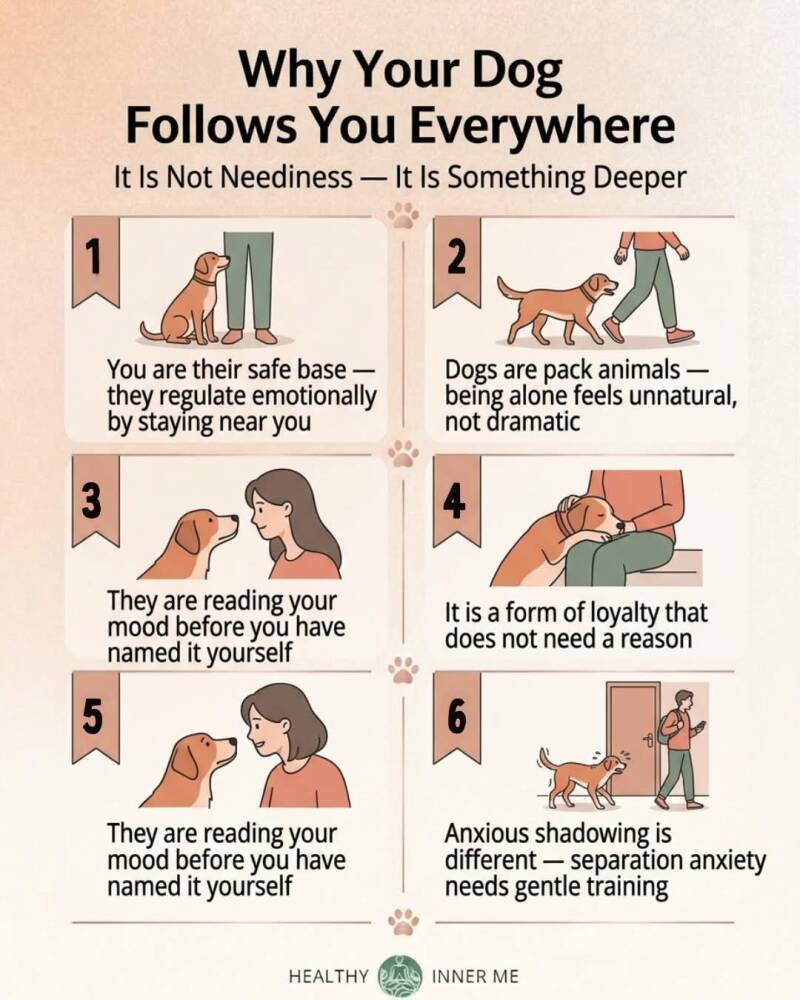
Your dog following you is not neediness in the way humans experience neediness. It is not anxiety, it is not clinginess, and it is not a sign that something is wrong with your dog's independence. It is one of the most ancient and intact instincts in the domestic dog: staying close to the safe member of the pack.
You are their safe base.
Dogs are not built to be alone. In the wild, a dog separated from its group is in genuine danger. The instinct to stay near the group leader — the one who provides food, protection, and the signal that everything is fine — is wired in deeply. When your dog follows you from room to room, they are doing what their entire biology tells them to do. You are the signal. Where you are is where safe is.
There is something else happening too.
Dogs read emotional states through scent, posture, breathing, and movement. Your dog is often reading your mood before you have fully registered it yourself. The following is partly about proximity and partly about monitoring you — checking whether you are okay, whether your energy is different from yesterday, whether they need to do something about it. When you sit down and exhale, they often settle immediately. They were waiting for that exhale.
The following is also a form of loyalty that does not explain itself. It does not follow you because it expects a reward. It follows you because you are its person.
There is one exception worth noting. If the following has become frantic — if your dog cannot tolerate any separation, shows distress when you prepare to leave, or is destructive when alone — that is separation anxiety, and it responds well to gradual training and sometimes to professional support. That version needs attention, not reassurance.
But the quiet shadow at your heels?
That is just love with four legs.
Let it follow.
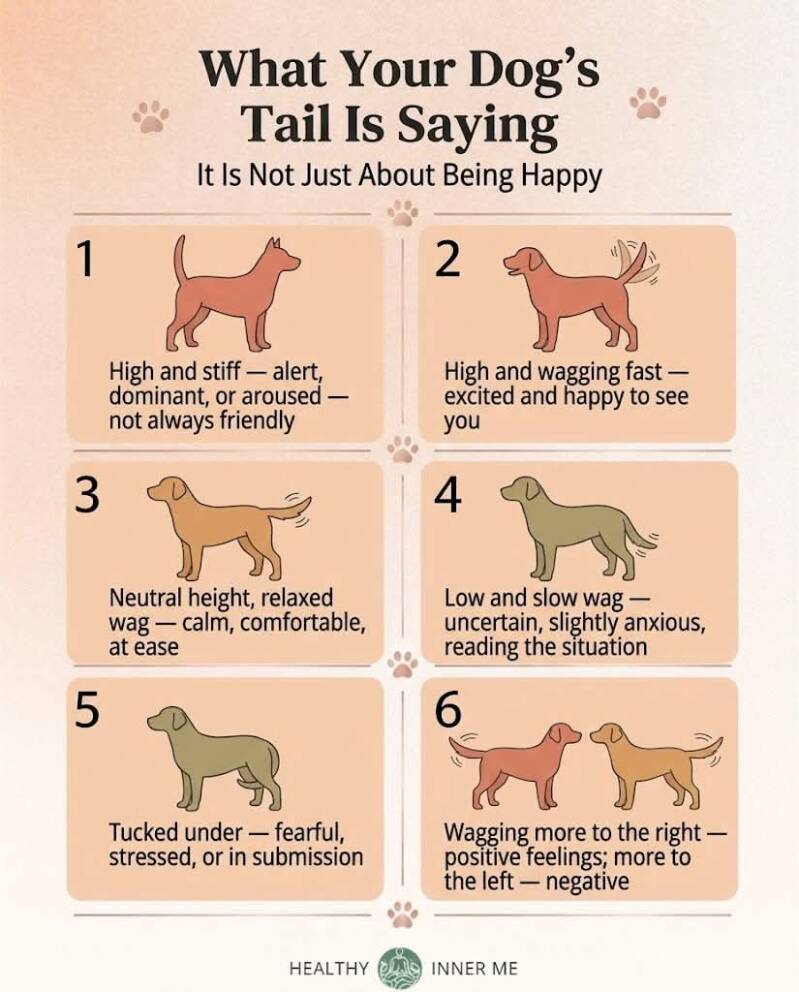
You have been reading your dog's tail wrong. Not completely, but not fully either.
Most people know that a wagging tail means a happy dog. That is true, but it is only one sentence of a much longer conversation. The tail is one of the most nuanced communication tools your dog has, and once you start reading it properly, you start understanding your dog in a completely different way.
Here is what the tail is actually saying.
High and stiff, barely wagging or held rigid
This is not a friendly greeting. This position signals alertness, arousal, or dominance. Dogs in this posture are not relaxed. They are assessing. If you see this directed at another dog or a stranger, pay attention before the situation develops further.
High and wagging fast, loose, almost full-body
This is the one everyone knows. Joy, excitement, I-see-you-and-I-love-you. This is genuine and uncomplicated.
Neutral height, soft and relaxed wag
This is contentment. Your dog is not excited or nervous. They are simply comfortable in the moment. This is the tail position of a dog who feels at home.
Low and slow, small wag
This is a dog who is uncertain. They are trying to be friendly but are reading a situation carefully. They may not be sure yet whether something is safe. This is not a tail that should be ignored. It is asking for patience and calm.
Tucked between the legs
Fear, stress, or submission. The tail tucked this way means the dog is feeling overwhelmed, threatened, or overpowered. This dog needs space and gentleness, not coaxing.
The direction of the wag
This one is newer in the research. Studies have found that dogs tend to wag more to the right when they feel positive emotions and more to the left when they feel negative ones. It is subtle, but other dogs can read it. Now you can too.
Watch the whole tail today.
Not just whether it is moving.
But how, where, and at what height.
Your dog has been saying so much more than you realized.
Your cat has been communicating with you every single night. You just didn't have the translation.
Cats are not random sleepers. Every position tells you something about how safe they feel, how warm they are, and how much they trust the world around them right now. Once you know what to look for, you start seeing a whole conversation you didn't know was happening.
Here is what each position actually means.
The Cat Spluff
Flat on their back, paws flopped in the air is the highest trust position a cat can offer. The belly is exposed. The vital organs are up. A cat that sleeps this way in your home is not just comfortable. They feel completely safe. This is a gift.
The Loaf
Paws tucked neatly underneath, eyes half-closed is a cat at rest but not fully off. They are warm, content, and conserving energy. It is their version of a cozy afternoon on the couch.
The Crouching Semi-Loaf
Paws slightly forward, chin lowered looks like a little sphinx. They are relaxed but have not fully powered down. Something in the room still interests them, even if only mildly.
The Tight Curl
Nose almost touching tail, a perfect circle is about warmth and security. When a cat curls toward you while doing this, they are choosing your proximity on purpose.
Side sleeping is the deeply-relaxed position. A cat on their full side has decided the world requires nothing of them right now. It often happens in warm rooms. It is also a deeply trusting position because they cannot spring upright quickly from it.
Snuggling up against another cat or against you is its own language. It means they want closeness more than they need personal space right now. That is not nothing for a creature that usually decides exactly how much distance they need.
The Monorail draped over the arm of a chair, limbs hanging is peak calm. No alertness at all. No need to be ready. Just existing in gravity.
Head pressing face pressed flat against the floor or wall is the one to watch. Occasional face-tucking for warmth is normal. But if your cat is pressing their head against surfaces repeatedly or in unusual ways, it can signal neurological discomfort and is worth a call to your vet.
Watch your cat tonight.
Notice the position.
It is telling you exactly how they feel.
They have been talking this whole time. Now you know some of what they are saying.

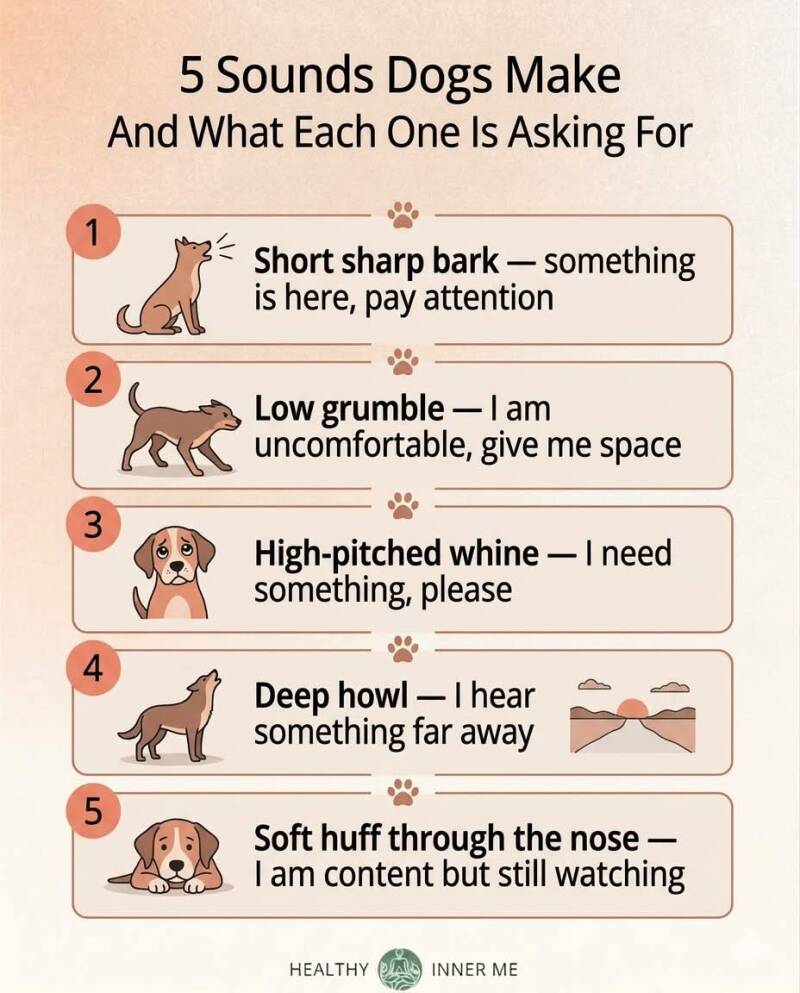
Your dog is talking to you.
Not the way a person does. But the vocabulary is real, and it is more specific than most people realize. Once you start matching the sounds to the situations they come from, the patterns become clear very quickly.
Dogs evolved alongside humans for tens of thousands of years. Part of what made that partnership work is that dogs developed an unusually complex vocal range specifically for communicating with us. Wolves, their closest relatives, do not bark nearly as much. Barking appears to be something dogs developed largely in response to living with people.
Here is what the five most common sounds actually mean.
The short, sharp bark one or two, then a pause. This is the alert bark. Something changed in the environment. A sound outside. A person approaching. A smell that does not belong. The dog is not alarmed yet. They are telling you: pay attention, something is here. Acknowledging it calmly, even just saying "I hear it", usually ends the sequence. The dog has done its job.
The low grumble or growl. This is a boundary signal, not aggression in most dogs. It means: I am uncomfortable, please stop. Dogs that growl are communicating. A dog that has been trained out of growling because it seemed rude may bite without warning instead. The growl is the warning system. It should be listened to, not corrected away.
The high-pitched whine. The frequency rises with the intensity of the need. At its lowest, it is a gentle "I would like something." At its highest, it is genuine distress. Most household whining sits in the middle — excitement, an unmet need, mild discomfort. Check the obvious first: does she need to go outside, has she been fed, is something physically off.
The deep howl. Dogs howl in response to sounds sirens, certain music, another dog howling nearby. It is a long-distance communication signal, designed to carry farther than a bark. Some dogs howl when left alone. That is a separation response, not a behavior problem. They are calling for the pack to come back.
The soft huff a short exhale through the nose, often with the dog looking away or settling their head down. This is one of the most content sounds a dog makes. It says: I am fine. I see you. I am resting now. It is easy to miss because it is quiet. But it is worth noticing.
Every dog has their own variations. A dog that is normally quiet and suddenly becomes vocal is worth paying attention to dogs sometimes vocalize when they are in pain in ways that do not look like pain.
The next time your dog makes a sound, notice what came just before it.
That context is usually the whole answer.
You probably understand more of it than you think.
Your dog has been trying to tell you things for your entire life together.
If you have a cat, you have heard it.
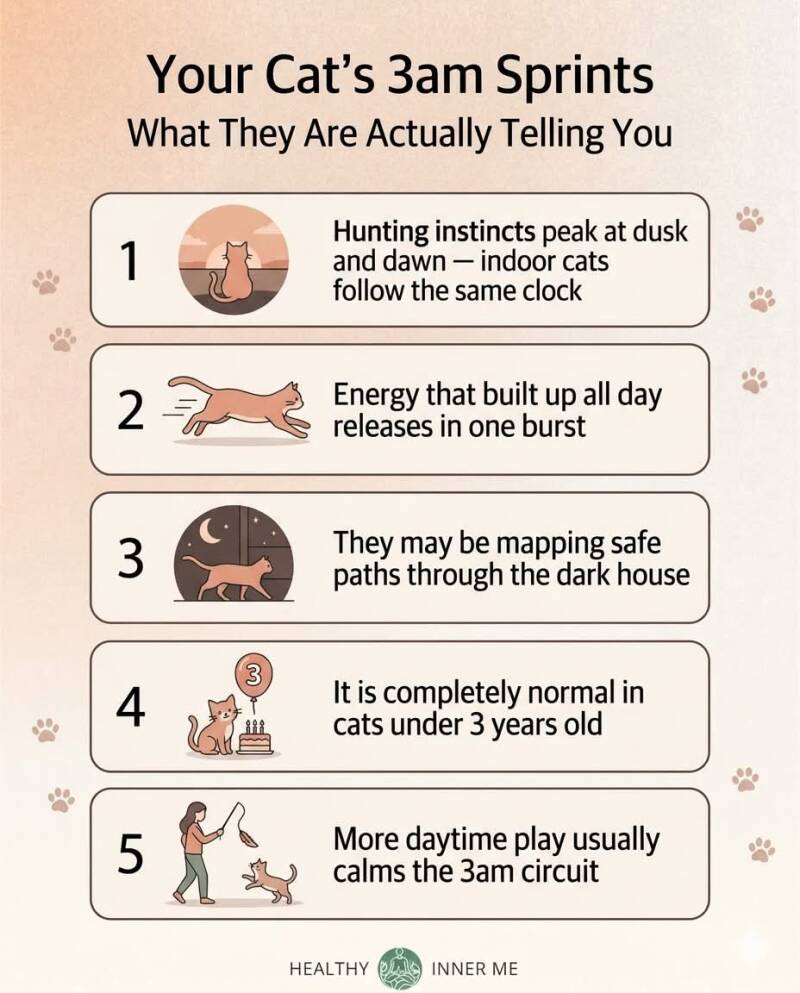
The sudden thunder at 3am. The sprint from one end of the apartment to the other. The leap, the turn, the sprint back. The pause. Then the whole thing again.
You lie there in the dark wondering if something is wrong.
Nothing is wrong.
Your cat is on a schedule that predates your apartment by several thousand years. Cats are crepuscular most active at dawn and dusk, which in the wild is when prey is most visible and the temperature drops just enough to make movement feel natural. Every instinct in that small body says: now.
The problem is that in your home, there is no prey. There is nothing to hunt. So the hunt happens anyway, played out in loops around your furniture at a speed that should not be possible for something that spent twelve hours sleeping on your laundry.
Here is what the 3am sprint is actually telling you.
The hunting drive is intact. Indoor cats do not lose the instinct just because they do not need it. The brain still cycles through the hunt sequence stalk, chase, pounce and it needs somewhere to put that energy. The sprint is the release. The circuit through the house is the hunt.
The energy built all day. If your cat was calm and slow during the day, that calm was not rest the way you experience rest. It was containment. Cats bank their physical energy and spend it in short explosive bursts. The 3am session is usually the largest withdrawal.
They may be mapping the safe paths. Some researchers believe cats move through their territory at night partly to check that nothing has changed. Running the full circuit is a kind of audit. Everything where it should be. Good.
It peaks between one and three years old. Young cats have more energy and less outlet. By four or five, most cats settle into a rhythm that disturbs you less. This is cold comfort at 3am but useful context.
More play during the day helps. A ten-minute interactive session before you go to bed a wand toy, something that mimics a hunt gives the circuit a proper ending. Cat catches prey. Cat is satisfied. Cat sleeps.
If the sprints are new and your cat is older, mention it to your vet. Sudden nighttime activity in a cat that was previously calm can sometimes signal something worth checking. Most of the time it is just cat logic. But it is worth noting.
Play with your cat for ten minutes before bed tonight.
Let them catch something, even if it is a toy.
See whether 3am gets quieter.
Your cat is not broken. Your cat is a small hunter living in your house, doing what small hunters do. The sprint is the wild part they never lost.
Which, if you think about it, is kind of remarkable.