Embracing the winds of change
Welcome to "The Four Winds," where we explore the symbolic power and spiritual significance of the cardinal directions and their associated energies. Discover how these ancient concepts can guide your journey and enrich your understanding of the world.

The whispers of the East wind
The East wind, often associated with new beginnings and fresh ideas, carries the energy of inspiration and dawn. It is linked to the element of air, representing intellect, communication, and clarity of thought. Embrace its gentle breeze to clear your mind and invite new perspectives into your life.

The steadfast South wind
The South wind brings with it the warmth of passion, growth, and vitality. Aligned with the element of fire, it embodies courage, transformation, and energetic action. Let the South wind ignite your inner strength and fuel your creative endeavors, pushing you towards your true potential.

The cleansing West wind
The West wind is deeply connected to emotions, intuition, and introspection. Associated with the element of water, it encourages healing, purification, and the flow of feelings. Allow the West wind to wash away what no longer serves you, promoting emotional balance and spiritual renewal.

The grounding North wind
The North wind embodies stability, wisdom, and material abundance. Linked to the element of earth, it represents grounding, protection, and endurance. Draw upon the steady energy of the North wind to anchor yourself, build a strong foundation, and manifest your desires.
Journey with the four winds
"The Four Winds" is a concept that invites you to recognize the profound influence of directional energies and elemental forces on your spiritual path. By understanding and aligning with these natural powers, you can navigate life's challenges and opportunities with greater awareness and intention. The main point is that by understanding the unique energies of each of the four winds, you can harness their power to enhance your spiritual practice and daily life.
THE WIND GODS OF GREEK AND ROMAN MYTHOLOGIES
GREEK
The Anemoi Anemoiaikas
The Anemoi are the titan-gods of the four winds and the four seasons, sons of Eos (Dawn) and Astraeus (Stars) — they are Boreas, Notus, Eurus, and Zephyrus.
Although they are lords of their own winds, they all serve Aeolus, keeper the Anemoi.
Boreas was the north wind and bringer of cold winter air
Eurus, the east wind, the bringer of autumn.
Notus was the south wind and bringer of the storms of late summer
Zephyrus was the west wind and bringer of light spring and early summer breezes
Caicias\Kaikais-North-NortheastThe Northeast Wind.
( The Anemoi Thuellai – the Tempest-Winds)
1. Kaikias, god of the Northeast wind
2. Apeliotes, god of the Southeast wind
3. Skiron, god of the Northwest wind
4. Lips or Livos, god of the Southwest wind
These wind gods were the sons of Eos, the dawn goddess and her husband, Astraeus, the god of dusk.
The eight wind gods portrayed are the four chief wind gods; Boreas – god of the North wind, Notus – god of the South wind, Eurus – god of the East wind, Zephyrus – God of the west wind and the four minor winds, Kaikias – Northeast, Apeliotes – Southeast, Lips or Livos – Southwest and Skiron – Northwest.
the Anemoi Thuellai, the Tempest-Winds:
1. Apeliotus – the south-east wind
2. Lips or Livos – the south-west wind
3. Sciron – the north-east wind
4. Kaikias – the north-west wind
Apeliotes was the god of the Southeast wind, thought to bring refreshing rain, advantageous to farmers.
Lips or Livos was the god of the southwest wind., or Skeiron, was the Greek god of the northwest wind.
Kaikias, whose name derives from the Greek kakía (κακία), meaning “badness” or “evil” was the god of the northeast wind, the bearer of snow, coldness and blizzards.
Apeilotes- the southeast wind.
Argestes- the northwest wind, the Athenians called him Sciron or Olympias due to his relation to the Scironian Rocks and Mt. Olympus.
Eurus (Εὖρος, Euros) according to some was the southeast wind
Euronotus, the wind blowing from the direction, as its name suggests, between Euros and Notus, that is, a south-southeast wind (Euroauster to the Romans)
BOREAS The god of the North-Wind is depicted with shaggy hair and beard, with a billowing cloak and a conch shell in his hands.
KAIKIAS (Caicias) The god of the North-East Wind is portrayed as a bearded man with a shield full of hail-stones.
APELIOTES The god of the East Wind appears as a clean-shaven man, holding a cloak full of fruit and grain.
EUROS (Eurus) The god of the South-East Wind who is sculpted as a bearded man holding a heavy cloak.
NOTOS (Notus) The god of the South Wind pours water from a vase.
LIPS The God of the South-West Wind is represented holding the stern of a ship.
ZEPHYROS (Zephyrus) God of the West-Wind is depicted as a beardless youth scattering flowers from his mantle.
SKIRON (Sciron) The god of the North-West is a bearded man tilting a cauldron, signifying the onset of winter.
They are:
Boreas (Greek)/Septentrio, a.k.a. Aquilo (Latin) - North Wind
Notos (Greek)/Auster (Latin) - South Wind
Eurus (Greek)/Subsolanus (Latin) - East Wind
Zephyr (Greek)/Favonius (Latin) - West
Argestes "clearing", a wind blowing from about the same direction as Skiron (Caurus), and probably another name for it
Aparctias, sometimes called the north wind instead of Boreas
Thrascias, the north-northwest wind (sometimes called in Latin Circius)
Iapyx, the northwest wind about the same as Caurus. It was this wind, according to Virgil, that carried the fleeing Cleopatra home to Egypt after she was defeated at the battle of Actium.
Libonotus, the south-southwest wind, known as Austro-Africus to the Romans
Meses, another Wind
Other minor wind deities are Kaikas, Caecius, Apeliotus, Caurus or Corus, Afer ventus or Africus.
• Argestes "clearing", a wind blowing from about the same direction as Skiron (Caurus), and probably another name for it
• Aparctias, sometimes called the north wind instead of Boreas
• Thrascias, the north-northwest wind (sometimes called in Latin Circius)
• Euronotus, the wind blowing from the direction, as its name suggests, between Euros and Notus, that is, a south-southeast wind (Euroauster to the Romans)
• Iapyx, the northwest wind about the same as Caurus. It was this wind, according to Virgil, that carried the fleeing Cleopatra home to Egypt after she was defeated at the battle of Actium.[22]
• Libonotus, the south-southwest wind, known as Austro-Africus to the Romans
• Meses, another name for the northwest wind
• Olympias, apparently identified with Skiron/Argestes
• Phoenicias, another name for the southeast wind ('the one blowing from Phoenicia', due to this land lying to the southeast of Greece)
Argestes
Argestes was the northwest wind, the Athenians called him Sciron or Olympias due to his relation to the Scironian Rocks and Mt. Olympus. The Romans knew him as Corus.
Lips
Lips was the god of the southwest wind he was named as such because the southwest wind comes from Libya. In Roman myth, he was renamed Africus.
Other Minor Wind Deities
Meses
Meses was the god of the north northeast.
Argest- There is no Roman name for him as they consider Aquilo the north northeast wind, Septentrio as the North Wind, and Caecus as the northeast wind.
Euronotus- was the god of the the south southeast wind, locally he is called Phoenicias, 'the one blowing from Phoenicia', due to this land lying to the southeast of Greece. He is called Euroauster to the Romans.
Libonotus
Libonotus was the god of the south southwest wind, he is also called Leuconotos or Libophoenix. He is called Austro-Africus to the Romans.
Thrascias
Thrascias was the god of the north northwest wind.
Miscellaneous
Aura
Aura was a daughter of Oceanus and was the goddess of breezes. She was sometimes split into multiple nymphs; the Aurae
Other minor wind deities included:
•Argestes "clearing", a wind blowing from about the same direction as Skiron (Caurus), and probably another name for it
Aparctias, sometimes called the north wind instead of Boreas
•Thrascias, the north-northwest wind (sometimes called in Latin Circius)
•Euronotus, the wind blowing from the direction, as its name suggests, between Euros and Notus, that is, a south-southeast wind.
Iapyx, the northwest wind about the same as Caurus. It was this wind, according to Virgil, that carried the fleeing Cleopatra home to Egypt after she was defeated at the battle of Actium.
•Libonotus, the south-southwest wind.
Meses, another name for the northwest wind
Olympias, apparently identified with Skiron/Argestes
Phoenicias, another name for the southeast wind ('the one blowing from Phoenicia', due to this land lying to the southeast of Greece)
Olympias, app, bringer of identified with Skiron/Argestes
Phoenicias, another name for the southeast wind ('the one blowing from Phoenicia', due to this land lying to the southeast of Greece.
ROMAN
THE MAJOR ROM
Septentriō (or Aquillon)-god of the North Wind, bringer of Winter
Vulturnus- god of the East Wind, bringer of Summer
Auster-god of the South Wind, bringer of Autumn
Favonius- the West Wind, bringer of Spring
The 4 Major Vinti are ruled by the storm god Aeolus. They were the children of the goddess of the dawn Eos and her husband, the god of the dusk, Astraeus.
MAJOR AND LESSER VENTI IN ORDER
Septentrio (or Aquilio) - god of North Wind
APELIOTES The god of the East Wind
EUROS (Eurus) The god of the Southeast Wind
NOTOS (Notus) The god of the South Wind
LIPS The God of the South-West Wind
ZEPHYROS (Zephyrus) God of the West Wind
SKIRON (Sciron) The god of the Northwest Wind
(NE),
Subsolanus (E),
Eurus (SE),
Euroauster (SSE),
Austeronotus (S),
Euronotus (SSW),
Africus (SW),
Zephirus (W),
Eurus (NW),
Circius (NNW).
The Four Winds and Their Correspondences
In mythology, folklore, and elemental magic, the Four Winds are personified deities or forces representing the four cardinal directions and the natural cycles of the seasons. Each wind carries distinct qualities, symbolism, and magical correspondences.
1. Boreas (North Wind)
Direction: North
Season: Winter
Mythology: In Greek myth, Boreas is the son of Eos (Dawn) and Aeolus, Keeper of the Winds. He is the god of cold, harsh winds and storms, often depicted with a beard and short tunic .
Symbolism: Bringer of winter, destruction, and change. In some tales, he is protective and even heroic, as in the story of sinking Persian ships .
Magical traits: Cold, strength, protection, and transformation.
Correspondences: Winter, cold, storms, protection, and sometimes warfare .
2. Zephyrus (West Wind)
Direction: West
Season: Spring
Mythology: Gentle, amorous god of the west wind, associated with fertility and renewal
Symbolism: Renewal, love, and the arrival of warmer weather.
Magical traits: Clarity, inspiration, and communication.
Correspondences: Spring, fertility, gentle change, and emotional balance.
3. Notus (South Wind)
Direction: South
Season: Summer
Mythology: God of the hot, desiccating winds of summer, often linked to storms and destruction of crops Flying the Hedge.
Symbolism: Intensity, heat, and the peak of growth before decline.
Magical traits: Passion, transformation, and purification.
Correspondences: Summer, heat, fertility, and sometimes destruction .
4. Aquilo (East Wind)
Direction: East
Season: Autumn
Mythology: Roman equivalent of Boreas, associated with winter gales.
Symbolism: Transition, change, and the end of one cycle.
Magical traits: Movement, clarity, and communication.
Correspondences: Autumn, change, and the movement of ideas
Elemental & Magical Links
In elemental magic, the Air element is connected to movement, communication, and wisdom, aligning with the winds’ role as messengers and agents of change
The Four Winds embody:
Change & Transformation – driving seasonal cycles and personal growth CompleteEra.
Communication – as messengers between worlds Flying the Hedge.
Directional energy – each wind tied to a cardinal point and season CompleteEra.
Summary Table:
Wind Direction Season Mythological Role
Symbolism
Boreas North Winter Storm, cold, protection
Strength, change
Zephyrus West Spring Fertility, renewal
Clarity, love
Notus South Summer Heat, storms, growth
Passion, transformation
Aquilo East Autumn Transition, change
Movement, communication
These correspondences are used in modern pagan, ceremonial, and elemental magic to align rituals, symbols, and intentions with the energies of the winds
Painting is "Boreas"
By John William Waterhouse
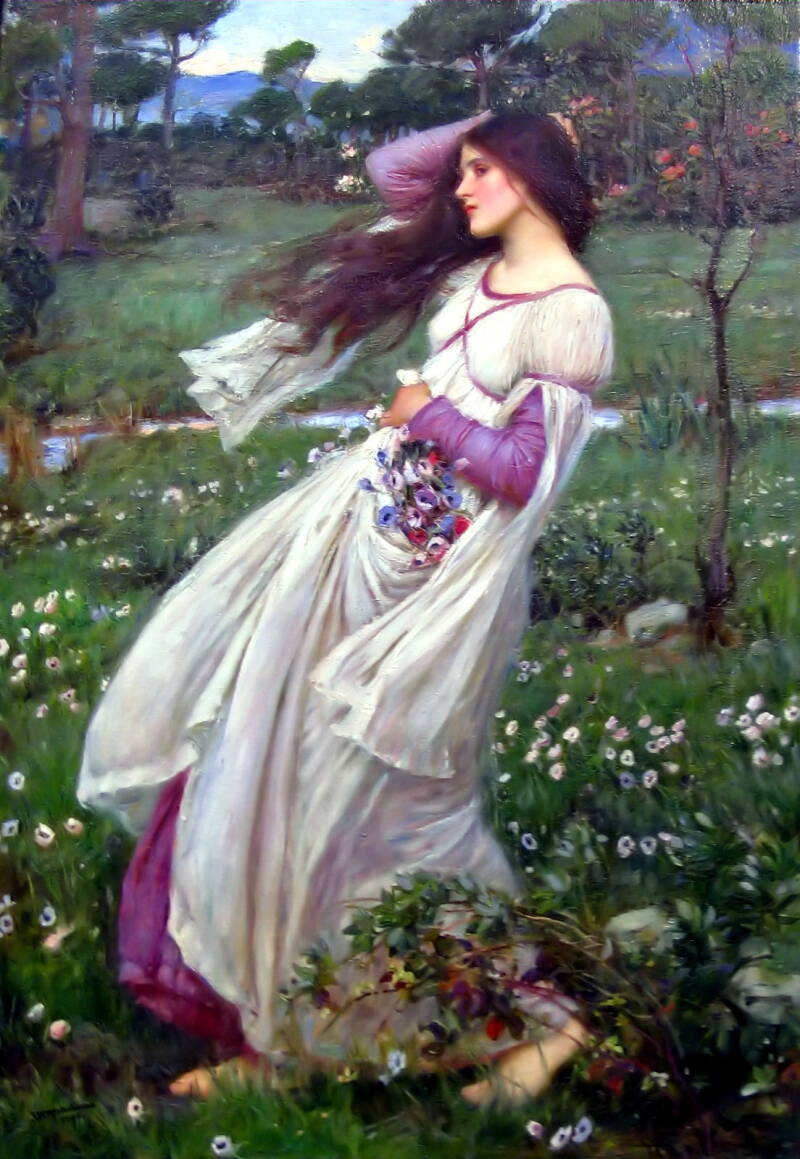
Painting is "Windflowers"
By John William Waterhouse