Welcome to the cauldron
Step into our sacred space where ideas bubble and transformations begin. The Cauldron is a vibrant hub for spiritual exploration, self-discovery, and community connection at The Altered Goddess. Here, we stir together ancient wisdom with modern insights to ignite your inner spark.

Brimming with transformative insights
Imagine a magical pot bubbling with an endless array of ideas, topics, and insights. The Cauldron is precisely that—a wellspring of knowledge and inspiration. We delve into diverse spiritual practices, offer guidance on personal development, and share stories that resonate with the depths of your soul. From unraveling ancient mysteries to navigating contemporary challenges with a spiritual lens, our content is crafted to enlighten and empower you.
.
What is a Cauldron?
A cauldron is defined as a “large metal pot with a lid and handle used to cook over an open fire.” The cauldron dates back to at least the late Bronze Age and was used for cooking and brewing purposes. The term “cauldron” is derived from old Norse and Germanic words meaning “hot place”. The term kettle is related to cauldron. (Fun fact, if your name is Corey, you are inherently linked to the cauldron since the word for cauldron in Middle-Irish is Coire).
The Witch’s Cauldron as a Magic Symbol
The cauldron symbolizes many things, namely the Divine Feminine, because it is viewed as the womb. It is related to creation, as in the womb of the earth. And therefore it’s associated with witches and goddesses. Because food and ingredients for remedies are placed inside a cauldron and then transformed, the cauldron is a symbol of transformation and alchemy.
Via Cerridwen’s Cauldron of Inspiration, it’s also a symbol of divine wisdom and rebirth. The four elements are an inherent part of every cauldron: the pot and food that goes inside, water and brews made inside, the fire that heats the cauldron, and the steam and smoke that comes out. The three legs represent the Celtic sacred number three: three main lunar phases, the life/death/rebirth cycle, and the triple goddess.
Where to Find YOUR Witch’s Cauldron of Inspiration and Magic
Cast iron cauldrons may be hard to come by, though. They can can also found on Ebay and Amazon. I’ve seen a few old cauldrons at thrift stores, flea markets and antique malls. If you’d like a smaller version of the cauldron, metaphysical shops online and locally sell them. Though the small cauldrons aren’t used for cooking or brewing, but moreso as an altar symbol or for spell work.
Some substitutions for the witch’s cauldron in modern times include any pot used on the stove or in the oven. A stockpot or a cast iron dutch oven are modern cauldrons, especially when cooked at your modern hearth – the stove/oven! I’ve also heard modern witches call crockpots, instant pots, and even pans their cauldron! So if you can’t find a large cauldron, a pot on the stove is the modern practice. I recommend keeping a cauldron for cooking food and herbal remedies separate from a cauldron for burning incense or candles.
The Witch’s Cauldron’s Magical Uses
If you’re fortunate enough to have a large cauldron over an open fire, it can be used in SO many ways! But if you don’t have the room or means, a smaller cauldron is just as magical as a large one. Remember, if you’re using your cauldron to cook or brew remedies, make sure it is FOOD SAFE (i.e. real cast iron that has also been seasoned).
No matter the size of your witch’s cauldron, here are the many magical uses:
- Cooking food
- Brewing herbal remedies and concoctions
- To burn loose leaf incense on charcoal disks (put some sand in the cauldron before putting the hot coal in it)
- Burning paper petitions
- Burning plant matter as offerings, etc.
- Burning loose incense on charcoals
- Burn candles for safe, long burning time
- The cast iron scrapings can be used to make witch’s black salt
- As a symbol of the goddess or all 4 elements on the altar and in ritual
- Scry (a form of divination) in water or liquid in the cauldron
- Put on the stove (if cast iron and kitchen-ready) to simmer seasonal potpourri for Yule, Samhain, etc.
Correspondences of the Cauldron
In Celtic and neopagan traditions, the cauldron is a sacred vessel with deep symbolic and elemental correspondences, representing nourishment, transformation, and the interconnectedness of life.
Elemental and Dúile Correspondences
In the Elements of the Cauldrons framework, each cauldron contains three dúile (elements) that define its nature and function :
-
Coire Sois – Knowledge
-
Sky / Head – The Father God, Dagda
-
Stars / Brain – The Guardian, Manannán
-
Sun / Face – The Champion, Ogma
-
-
Coire Goriath – Incubation
-
Moon / Mind – The Cow Goddess, Bóann
-
Wind / Breath – The Wisdom Goddess, Brighid
-
Sea / Blood – The Battle Goddess, The Morrígan
-
-
Coire Erma – Vocation
-
Nature / Skin – The Stag God
-
Earth / Flesh – The Mother Goddess, Anu
-
Stone / Bones – The Hag, The Cailleach
-
These elements correspond to aspects of the self and the world, with deities representing their rulers. The cauldron’s flow is tied to the “synchronized experience of All That Is” (Danu) and the “Power of Chaos” (Domnu), connected by the sacred fire of the Tree Bile .
Western Elemental Correspondences
From a broader magical perspective, the cauldron’s energies can be mapped to the four classical elements :
-
Earth – Physical body, grounding, material wealth, winter, night.
-
Air – Spirit, breath, intellect, communication, spring, dawn.
-
Fire – Transformation, passion, life force, summer.
-
Water – Emotion, intuition, healing, renewal, autumn, night.
In Celtic myth, the cauldron often embodies Water (life, nourishment) and Earth (foundation, sustenance), but also carries the transformative fire of rebirth.
Symbolic Meanings
Across cultures, the cauldron symbolizes:
-
Nourishment and abundance – e.g., the Cauldron of Plenty in Celtic tales .
-
Transformation and rebirth – as in the Pair Dadeni cauldron that revives warriors .
-
Wisdom and hospitality – linked to Dagda’s never-empty cauldron .
-
Connection to the divine – a vessel through which gods and nature interact.
Practical Use
In meditation or ritual, practitioners may:
-
Quiet the cauldron by relaxing the body (bones, flesh, skin) to align with its elemental correspondences .
-
Use elemental correspondences to draw in the energies of the cauldron for healing, inspiration, or transformation.
-
Meditate on the associated deities to deepen connection to the cauldron’s power.
In essence, the correspondence of the cauldron blends Celtic mythic symbolism with magical elemental mapping, making it a rich tool for spiritual work, self-discovery, and ritual practice.

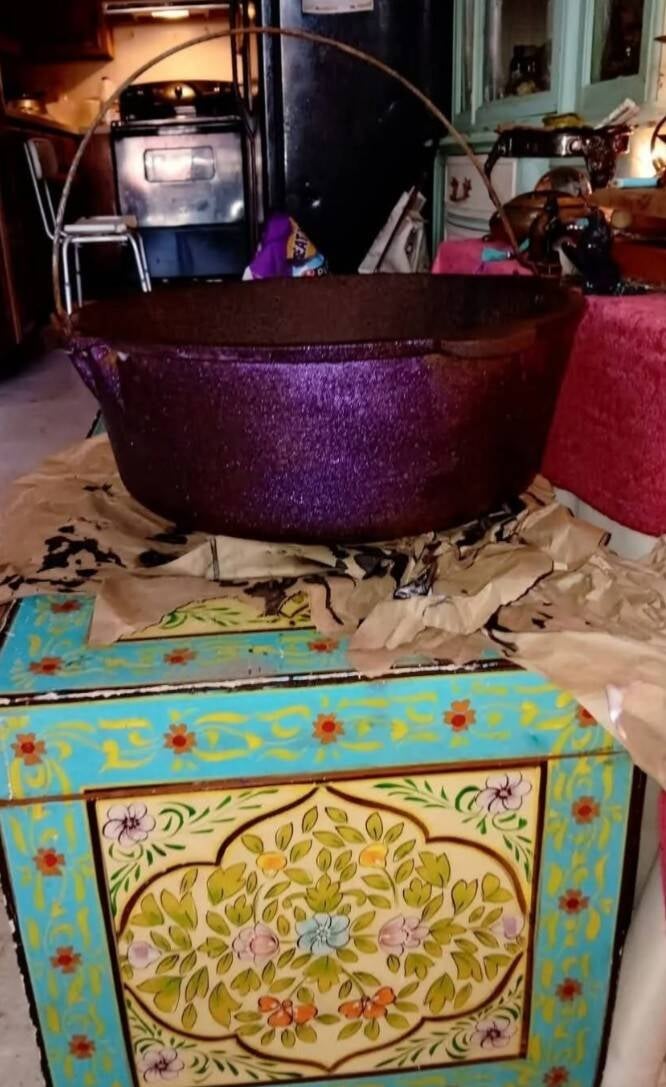
Next, we have my medium cauldron. My "Water" cauldron. Don't know why its called that, but my heart just spoke it. I use it for small gatherings and rituals. She to is participating in "Cauldron Spay Day" she gets a oil rub down with mico fine purple glitter in it. I mean, what girl doesn't like to sparkle in candlelight.

This, this is my oldest and dearest cauldron...my altar cauldron. She helps me with my spells and prayers.
This is my Sunday Morning Coffee and Chocolate ritual. It utilizes the magickal tools, cauldron and chalice.
I miss doing my Sunday Morning Chocolate and Coffee ritual. This little ritual is to set aside time to relax and unwind. I'd plan my week and decide what I wanted to do magickally in the coming week.
It's very easy to do, not complicated at all. Fill your designated coffee cup or chalice with some of that wonderful brew.If you don't drink coffee you can use whatever you'd like.
Next place some chocolate on a small plate. I liked to use mini Resse's Cups because when I place it outside later on, the squirrels really enjoy them.You will also need strips of paper, a pen, a fire source, a tea-light candle, an the strips of paper, write what you'd like to do or need to do for the mundane. Then write your plans for the magickal in the week to come.
Next light the candle then light the strips of paper one at a time and place them in the fire proof container. While you do this think calm thoughts, think about the best way to do the things you need to do. Let the strips burn out. After the ashes cool completely add them to your black salt.
After you've finished, take the chocolate and coffee outside for the children of the Forrest and outdoors to enjoy. For me that was usually squirrels. I also gave them peanuts in the shell. The next morning, I'd go out and collect my dishes.