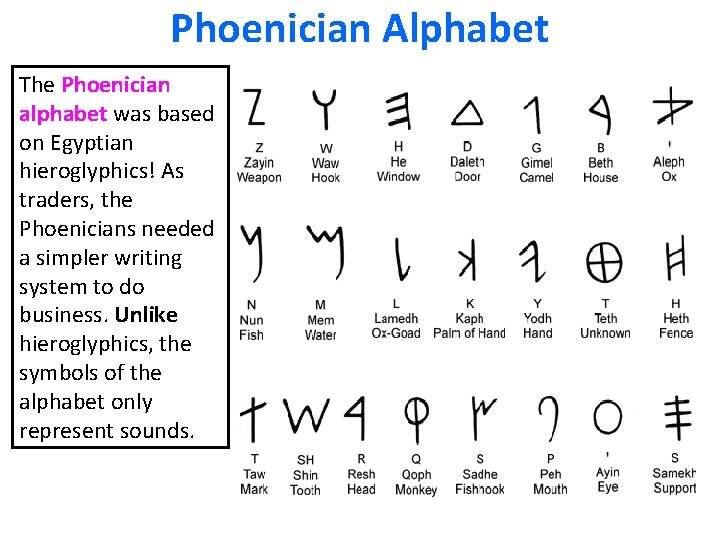
The Phoenician alphabet is an ancient writing system, developed around 1050 BCE, which became the precursor to most modern alphabets, including Greek and Latin.
Overview
The Phoenician alphabet originated in the ancient civilization of Phoenicia, located along the eastern Mediterranean coast (modern-day Lebanon, Syria, and northern Israel). It was a consonant-only script, also known as an abjad, consisting of 22 symbols, each representing a consonantal sound. Vowels were generally not indicated in writing, which was adequate for the language and context of use at the time.
Structure and Characteristics
- Direction: Written from right to left.
- Symbols: 22 letters representing consonants such as aleph (ʾ), beth (b), gimel (g), daleth (d), through taw (t).
- No vowels: Readers inferred vowels from context, which worked efficiently for Semitic languages.
- Simplicity: Each symbol was relatively abstract; the script was linear and easy to carve on clay, stone, or inscribe on papyrus.
Historical Significance
- Adaptability: Its simplicity made it widely adoptable compared to complex writing systems like cuneiform or Egyptian hieroglyphs.
- Influence: The Phoenician alphabet was directly adapted by the Greeks around the 8th century BCE, who added distinct symbols for vowel sounds. This adaptation eventually gave rise to the Latin and Cyrillic alphabets, making Phoenician the distant ancestor of many modern European writing systems.
- Economy and Trade: Phoenician merchants used the alphabet for trade documentation, contracts, and correspondence, which helped spread literacy along the Mediterranean.
Legacy
The Phoenician alphabet is often celebrated as one of the first true alphabetic writing systems, where a small set of symbols represents sounds rather than words or syllables. Its introduction dramatically simplified writing, enabling broader literacy and communication, and laid the foundation for alphabetic systems still in use today.In summary, the Phoenician alphabet was revolutionary for its time, creating a framework for subsequent alphabets and significantly influencing written communication across the ancient world.