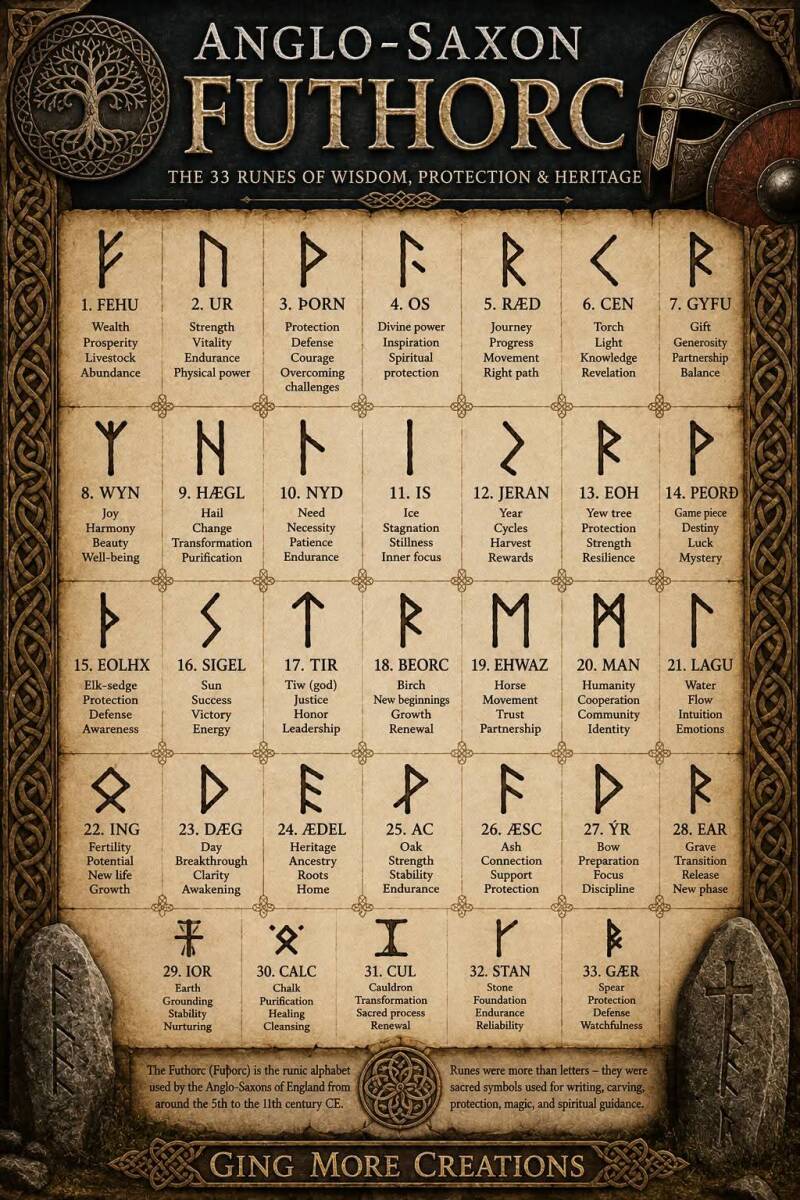
Anglo-Saxon runes, also known as the futhorc, were a writing system used in early medieval England, serving linguistic, cultural, and magical purposes.
Historical Background
Anglo-Saxon runes evolved from the Elder Futhark, the older runic alphabet used in continental Germanic regions. Around the 5th and 6th centuries, the Anglo-Saxons modified and expanded the Elder Futhark to suit the Old English language, resulting in the futhorc alphabet, named after its first six letters: f, u, þ, o, r, c.The expansion was necessary because Old English had more phonemes than the Elder Futhark could represent. Consequently, the futhorc included 28 to 33 characters, depending on the period and manuscript tradition.
Structure and Characters
The futhorc runes covered consonants, vowels, and diphthongs. Some notable features include:
- Uniquecharacterslikeᚩ(os),representingthevowel/o/,andᚪ(ac)for/a/
- The rune ᚦ (thorn), used for the voiceless dental fricative /θ/ as in “thin”, is a character that persists in modern Icelandic.
- Several runes had magical, symbolic, or mnemonic significance, often tied to their names and meanings (e.g., rad rune ᚱ meaning “journey” or “ride”).
Usage
Anglo-Saxon runes were primarily used for:
- Inscriptions on objects such as jewelry, weapons, bracteates (small gold medallions), and stones. For example, the Franks Casket, a whalebone box from the 8th century, is a famous artifact covered in runic inscriptions depicting mythological and biblical scenes.
- Memorial purposes, such as the runestones raised in memory of the deceased.
- Everyday writing was less common; Latin script eventually replaced runes for most practical writing after Christianization.
- Magical and ritual contexts, including charms and talismans, where runes were believed to hold protective or prophetic power.
Decline
With the spread of Christianity in England from the 7th century onward, the Latin alphabet became dominant. Runic literacy gradually declined in favor of Latin script, but runes persisted in decorative and ritual uses until at least the 11th century.
Legacy
Anglo-Saxon runes are an important part of linguistic and cultural history. They provide scholars with insights into Old English phonology, early medieval art, and belief systems. Today, they are studied in archaeology, historical linguistics, and runology, and they inspire modern pagan and cultural revivals.Key Points:
- Anglo-Saxon runes = futhorc, evolved from Elder Futhark
- Used in inscriptions on artifacts, memorials, and magical texts
- Expanded for Old English phonemes
- Declined after Christianization and adoption of Latin script
Understanding Anglo-Saxon runes offers a window into the early medieval English world, blending language, symbolism, and artistic expression