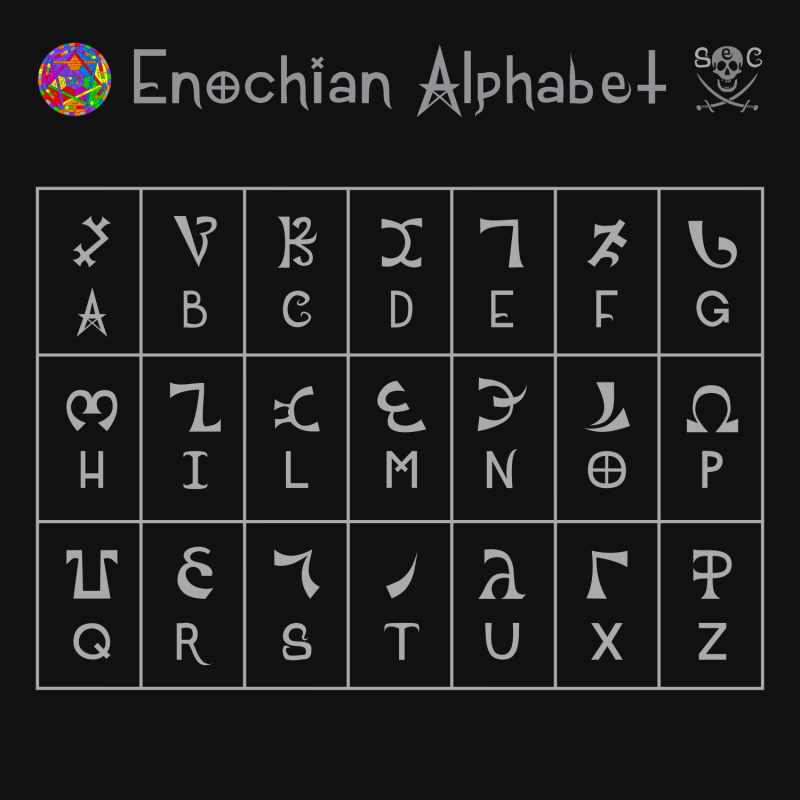
The Enochian alphabet is a mystical script reportedly received by John Dee and Edward Kelley in the 16th century, used in occult practices and called the "language of angels."
Origin and History
The Enochian alphabet was introduced to the world through John Dee, an English mathematician, astronomer, and occultist, and his scryer Edward Kelley during the late 1500s. Dee and Kelley claimed that the letters and associated language were revealed to them by angels during spiritual communications. The name "Enochian" honors the biblical figure Enoch, who was said to have spoken with angels and had knowledge of hidden wisdom.
Structure
The alphabet contains 21 letters, each with a distinct shape and name. Unlike modern alphabets, the Enochian script does not follow conventional phonetic rules, although Dee and Kelley provided some guidance on pronunciation. Each letter corresponds to sounds and words in the Enochian language, which also includes its own vocabulary and grammar patterns.The script is written using unique symbols, and many practitioners draw or inscribe these letters for spiritual or magical purposes. The letters are often used in rituals, talismans, and invocations, especially in the traditions of ceremonial magic, such as those practiced in the Hermetic Order of the Golden Dawn and modern occultism.
Usage and Cultural Significance
The Enochian alphabet serves as part of a larger system known as the Enochian magical system, which includes calls or "keys," angelic invocations, and complex symbolic diagrams. Practitioners believe this system grants access to spiritual realms or angelic guidance. Scholars generally consider it a product of Renaissance occultism, blending mysticism, language invention, and esoteric symbolism.While there is no evidence that Enochian was ever a natural or spoken language beyond printed texts and Dee’s writings, the alphabet remains influential in modern magical traditions, occult literature, and esoteric studies.In summary, the Enochian alphabet is a symbolic script linked to angelic communication, created in the Renaissance by John Dee and Edward Kelley, used primarily in ceremonial magic to explore spiritual knowledge and mystical practices.