1. Origins of the 'Passing the River' Alphabet
The Passing the River alphabet—also known as Transitus Fluvii (Latin) or Passage du Fleuve (French)—is an occult script first described by Heinrich Cornelius Agrippa in his Third Book of Occult Philosophy (early 16th century, around 1510–1533). It consists of 22 characters and is derived from the Hebrew alphabet. The name may reference the historical crossing of the Euphrates by the Jews returning from Babylon, symbolically representing transition or passage. The alphabet is part of Agrippa’s compilation of mystical scripts, including Celestial and Malachim alphabets, and was intended for esoteric, ritual, or magical use rather than practical communication.
The Passing the River alphabet is an abjad-style script (consonant-based) traditionally written right-to-left, reflecting its Hebrew derivation.
2. Anglo-Saxon Runes (Futhorc)
Anglo-Saxon runes, also called Futhorc (from the first six runes ᚠᚢᚦᚩᚱᚳ), are a native Germanic alphabet used approximately from the 5th to 11th centuries in England and Frisia. The Futhorc expanded from the 24-rune Elder Futhark to about 28–33 characters, adapting runes to represent Old English phonology, including new vowels and diphthongs.
Key features:
- Type: Alphabetical runic writing system
- Direction: Left-to-right
- Functional role: Writing Old English / Anglo-Frisian language; inscriptions, poetry, and symbolic or magical uses
- Representative artifacts: Franks Casket, St. Cuthbert’s coffin, Whitby combs
- Symbolism: Each rune has a traditional name representing objects, ideas, or deities (e.g., ᚠ Feoh = wealth; ᚦ Thorn = defense; ᛇ Eoh = yew/death).
3. Comparative Context
The Passing the River alphabet and Anglo-Saxon runes share symbolic and ritual dimensions but differ fundamentally:
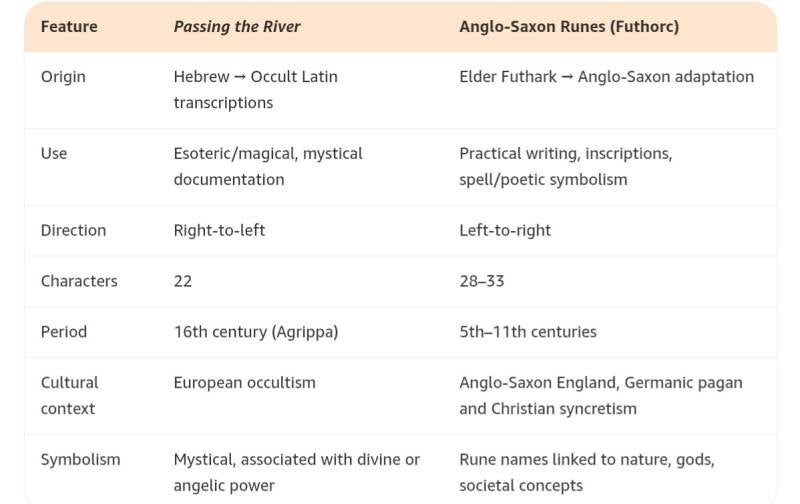
4. Conceptual Parallel
Both systems encode linguistic or symbolic meaning in individual characters, bridging phonetics with semiosis:
- Futhorc runes: letters serve as phonemes but retain symbolic/ritual meaning, used ideographically in literature and charms.
- Passing the River: letters are primarily ritual/mystical symbols, abstracting Hebrew-derived shapes into a magical alphabet.
The idea of “passing” or “transition” resonates conceptually with runes in Anglo-Saxon culture, where runes themselves were seen as vehicles of secret knowledge (rūn = secret/mystery). Although the scripts emerged in different periods and for distinct purposes, both intertwine writing with esoteric or symbolic power.
5. Conclusion
“Passing the River” (Transitus Fluvii) is a ritualistic, exotic alphabet derived from Hebrew, while Anglo-Saxon runes (Futhorc) developed from Germanic script traditions to transcribe Old English. Conceptually, they converge in treating letters as signs carrying both phonetic and magical or symbolic significance. Studying them together highlights the broader European tendency to imbue scripts with mystical, cosmological, or ritual importance across time, from early medieval Britain to Renaissance occult philosophy.
References
- Agrippa, Heinrich Cornelius. Third Book of Occult Philosophy. Cologne, 1533.
- Page, R. I. An Introduction to English Runes. Boydell Press, 1999.
- Omniglot: Passing the River
- Wikipedia: Anglo-Saxon Runes
