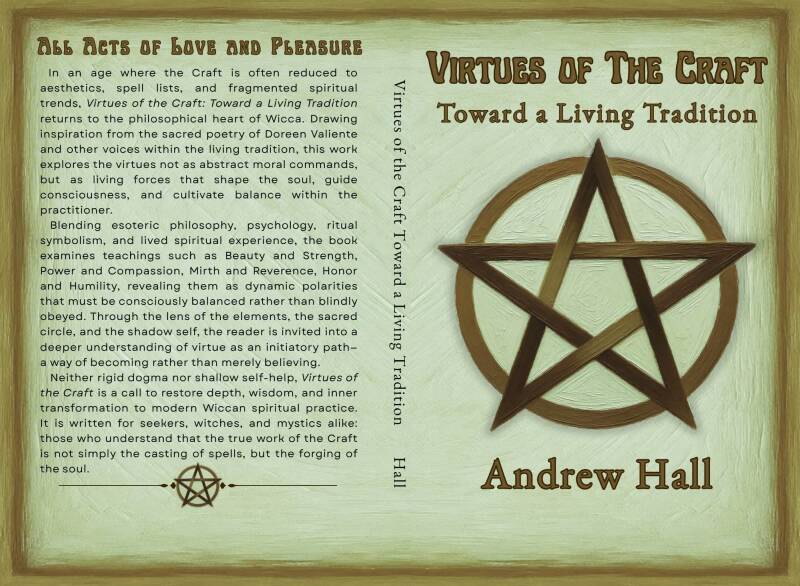
Stephanie Earl(SE) of The Altered Goddess, interviewed Author Andrew Hall(AH) June 13, 2026.
SE: What inspired you to write this particular Wicca and Witchcraft book series?
AH: The inspiration came from looking at the current landscape of Wiccan and Craft literature and realizing something vital was missing. There is absolutely nothing wrong with beginner guides or spellbooks—they have their place—but the market has become incredibly repetitive. Wicca is an evolving, living tradition that grows with the times, yet we rarely see new literature tackling its deeper, religious, and philosophical core. I wanted to write the book I wasn't seeing on the shelves.Virtues of the Craft actually began two decades ago as a college paper and bloomed through 20 years of my own thoughts, active practice, and personal transformation. I wanted to move past simple spellwork and provide a rigorous synthesis of the eight ideals from the Charge of the Goddess. By blending these elemental principles with classic virtues, I set out to create a cohesive moral framework—a poetic yet practical system to help practitioners achieve true balance and harmony in a chaotic world.
SE: What themes or questions about Wicca and Witchcraft do you hope readers take away from your work?
AH: I want readers to realize that Wicca is so much more than just casting spells; it is a deeply profound, lived philosophy. The central theme of the book is that balance is not a static state you achieve once and keep forever. We are human, none of us are perfect, and we are constantly swaying between states of alignment and misalignment. I want readers to ask themselves: “Where am I out of step with the virtues, and do I have the courage to look into the dark to fix it?”Everything casts a shadow. If you want to find your imbalances, you have to be willing to look directly at that shadow. I hope readers walk away with a deeper psychological and magical toolkit, learning to use the elemental couplets not just as abstract lore, but as a mirror to recognize their own instability and actively correct it.
SE: What’s one thing readers might not know about your book, Virtues of the Craft, A Living Tradition, that’s not obvious from the title or cover?
AH: Looking at the cover, someone might expect a standard history or a simple Book of Shadows. What they won't immediately see is that this book bridges the gap between deep philosophical inquiry, psychological introspection, and heavy magical practice. It’s a multi-layered text.While it is structured as an advanced system, I intentionally wrote it in a way that an insightful beginner can pick it up and grasp the overarching vision. It doesn't just hand you rituals; it provides extensive, carefully composed historical lore and educational material. It shows you the anatomy of a living religion, mapping out daily workings, magical exercises, and a major ritual for each elemental couplet to help you tune into these virtues on a cellular level.


SE: What research did you do to create your personal Wicca and Witchcraft practices?
AH: The research for this book wasn't a quick academic dive; it’s the culmination of 20 years of active, lived experimentation and study. It began by micro-analyzing the traditional Craft literature, specifically the Charge of the Goddess, and pulling at the threads of its moral philosophy. From there, I expanded outward, studying classical virtue ethics, psychology, and how different cultures have historically used elemental frameworks to understand human behavior.But the most important research was done in the field of my own life. It involved taking these abstract philosophical concepts and testing them through daily application and intense magical workings. Over two decades, I observed how these principles interacted with the human ego, how they manifest when warped by modern stress, and how the elemental couplets could be practically synthesized to heal real-world fractures in the self.
SE: How do you decide which Witchcraft traditions or spells to include?
AH: Every single daily working, exercise, and major ritual in this book had to earn its place through a strict filter of utility and depth. I chose to completely bypass superficial, theatrical spells that only scratch the surface. Instead, I focused entirely on a structured system built around the eight ideals of the Charge. I looked for workings that directly correspond to the elemental couplets, ensuring they serve a specific, evolutionary purpose: highlighting imbalance and restoring harmony. If a ritual or piece of lore didn't directly contribute to the reader's ability to diagnose their own shadow or tune into the virtues, it was left out. Every inclusion is deliberate, designed to show how Wicca operates as a living, breathing, religious tradition.
SE: Were there any passages or rituals you found particularly challenging to write?
AH: Striking the right balance in the tone was a massive challenge. I wanted the book to have an advanced, serious weight to it, but it was crucial that I didn't lock beginners out. Writing the sections on the shadow sides of the virtues required a lot of care. It is hard to write about personal imbalance and the flaws of the ego without sounding overly clinical or detached.The major rituals for each couplet were also demanding. They couldn't just be poetic poetry read off a page; they needed to be potent, working psychological and magical catalysts. Evoking the raw, elemental power of each virtue while providing clear, structured steps for the reader required a high level of literary and magical precision.
SE: How has your Craft evolved since you first began writing?
AH: When this project started as a college paper 20 years ago, my understanding of the Craft was much more academic and exploratory. Over two decades of active writing, rewriting, and daily practice, my Craft has evolved from a collection of meaningful acts into a fully integrated, living philosophy. Writing this book stripped away any remaining naive notions of perfection. It forced me to accept that the goal of the Craft isn't to become a flawless, untouchable being, but to become an expert at self-correction. My personal practice has become far more grounded in the religious and psychological reality of the living tradition—less about escaping the world, and entirely about creating harmony within it.
SE: How has your own interest in and experience with Wicca and Witchcraft influenced your writing?
AH: Because I view Wicca as a living, evolving religion, I cannot write about it as if it’s a dead museum piece or a superficial hobby. My deep interest in ontology, psychology, and philosophy completely shapes the landscape of my prose. I write from the perspective of an active practitioner who has used this exact system to navigate the highs and lows of life for twenty years.That lived experience infuses the book with an authentic, practical sternness mixed with genuine encouragement. I know exactly how hard it is to face your own shadow and admit where you are unbalanced. Because I've done that heavy lifting myself, my writing speaks to the reader as a peer who understands the work, respects the tradition, and refuses to offer cheap, fluffy shortcuts to spiritual maturity.
SE: What’s next in your Wicca and Witchcraft series?
AH: Now that Virtues of the Craft has established a firm system for moral balance, elemental alignment, and recognizing the shadow, the next step is to follow the mythic current completely into the deep. My next book focuses on the Descent of the Goddess and the raw, transformative reality of deep shadow work. If Virtues of the Craft taught us how to recognize our imbalances, this next work is the guidebook for stepping willingly into the underworld to correct them. It strips away the modern, comfortable misconceptions about shadow work and treats it as a sacred, psychological, and magical necessity. It follows the mythic architecture of the Descent to show how we must shed the illusions of the ego, face the heavy truths of our personal underworld, and ultimately reclaim our power from the dark. It is a natural, deeper, and unyielding evolution of the living tradition.


SE: What advice would you give to aspiring authors who want to write about Wicca and Witchcraft?
AH: Write the book that reflects your actual, lived depth, not just what is trendy on social media. The world does not need another basic spellbook that copies the last ten versions before it. We are part of a living, evolving religion, and it desperately needs authors who are willing to contribute serious literature to its theological and philosophical growth.Don't be afraid to tackle advanced concepts, but always strive to write them with a clarity that can still guide a beginner. Ground your writing in your own years of practice and your own human flaws. Show your readers your scars and your imbalances, because it is through our willingness to examine the shadow that we create books with real, transformative gravity.
Click on the book to be taken to its Amazon listing!