Journey to the heart of Eastern wisdom
Explore the profound insights of Eastern elements and their timeless wisdom. Discover how ancient philosophies can illuminate your path to inner peace and understanding, guiding your spiritual journey.

Understanding the core elements
Delve into the fundamental concepts of Eastern elements, such as the Five Elements (Wood, Fire, Earth, Metal, Water) in Chinese philosophy or the Tattvas in Indian traditions. Learn about their characteristics, symbolic meanings, and how they influence the natural world and our inner selves. This section provides a foundational understanding to begin your exploration.
Integrating ancient wisdom into modern life
Discover practical ways to apply the principles of Eastern elements to your daily life. Explore how balancing these energies can enhance your well-being, foster harmony in your environment, and deepen your spiritual practice. From Feng Shui principles to mindful living, find inspiration for a more balanced existence.

Personal reflections and spiritual growth
The journey with Eastern elements is a deeply personal one. This section invites you to reflect on how these ancient teachings resonate with your own "Altered Goddess" path. Find guidance on how to use these concepts as tools for self-discovery, personal empowerment, and connecting with the universal energies that shape our world.
Eastern Ancient Elemental Correspondences
In traditional Chinese philosophy, the Wu Xing (五行) — often translated as the Five Elements or Five Phases — is a fivefold conceptual scheme (wood, fire, earth, metal, water) used to explain natural processes, human health, and cosmology. Each element has a set of correspondences that link it to other aspects of the world.
Core Elements and Their Correspondences
According to classical sources
-
Wood – Color: Blue/Green; Direction: East; Season: Spring; Flavor: Sour; Associated with growth, expansion, and the liver in traditional Chinese medicine.
-
Fire – Color: Red/Scarlet; Direction: South; Season: Summer; Flavor: Bitter; Associated with transformation, energy, and the heart.
-
Earth – Color: Yellow; Direction: Center (Southwest or North); Season: Late Summer; Flavor: Sweet; Associated with nourishment, stability, and the spleen/stomach.
-
Metal – Color: White; Direction: West; Season: Autumn; Flavor: Pungent; Associated with contraction, clarity, and the lungs.
-
Water – Color: Black; Direction: North; Season: Winter; Flavor: Salty; Associated with stillness, depth, and the kidneys.
Generative (Supportive) Cycle
Elements “generate” or support the next in a clockwise sequence:
-
Wood → Fire (wood fuels fire)
-
Fire → Earth (fire produces ash/earth)
-
Earth → Metal (earth produces ores/metal)
-
Metal → Water (metal is refined by water)
-
Water → Wood (water nourishes seedlings/wood)
Destructive (Overcoming) Cycle
Elements “overcome” or weaken the next in a counterclockwise sequence:
-
Wood overcomes Earth (roots penetrate soil)
-
Earth overcomes Water (soil absorbs water)
-
Water overcomes Fire (water extinguishes fire)
-
Fire overcomes Metal (fire melts metal)
- Metal overcomes Wood (tools cut wood)
Applications
These correspondences are used in:
-
Medicine – diagnosing and treating imbalances in the body’s elemental energies.
-
Geomancy/Feng Shui – aligning buildings and spaces with favorable elemental directions.
-
Agriculture – understanding seasonal cycles and crop growth.
-
Philosophy and Cosmology – explaining natural cycles and human society.
In ritual and symbolic contexts, these directional and elemental links are often visualized in diagrams showing the generative and destructive cycles, helping practitioners align actions with cosmic rhythms.
Inter-promoting
The generative cycle ( xiāngshēng) is:
- Wood feeds Fire as fuel
- Fire produces Earth (ash, lava)
- Earth bears Metal (geological processes produce minerals)
- Metal collects, filters and purifies Water (water vapor condenses on metal, for example)
- Water nourishes Wood (water leads to growth of flowers, plants and other changes in nature)
Inter-regulating
The destructive cycle (xiāngkè) is:
- Wood grasps (or stabilizes) Earth (roots of trees can prevent soil erosion)
- Earth contains (or directs) Water (dams or river banks)
- Water dampens (or regulates) Fire
- Fire melts (or refines or shapes) Metal
- Metal chops (or carves) Wood
Overacting
The excessive destructive cycle ( xiāngchéng) is:
- Wood depletes Earth (depletion of nutrients in soil, over-farming, overcultivation)
- Earth obstructs Water (over-damming)
- Water extinguishes Fire
- Fire melts Metal (affecting its integrity)
- Metal makes Wood rigid to easily snap.
Weakening
The reverse generative cycle ( xiāngxiè) is:
- Wood depletes Water
- Water rusts Metal
- Metal impoverishes Earth (erosion, destructive mining of minerals)
- Earth smothers Fire
- Fire burns Wood (forest fires)
Counteracting
A reverse or deficient destructive cycle (xiāngwǔ or xiānghào) is:
- Wood dulls Metal
- Metal de-energizes Fire (conducting heat away)
- Fire evaporates Water
- Water muddies (or destabilizes) Earth
- Earth rots Wood (buried wood rots)
The five seasons, the five elements
The elements, the phases, are often explained on the basis of the seasons. They reflect the movement, temperature and events related to each element. Telling about the seasons is an accessible way to explain the meaning of the Taoist five elements, and how the five elements are used in some Traditional Chinese Medicine (TCM) methods.
The 5 seasons are: Spring, Summer, Harvest (or late summer), Fall, and Winter.
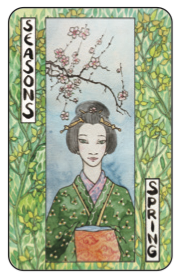
Wood element, season: spring
In the spring there is a rapid exponential growth. Many new forms arise from seeds that have rested, dormant and germinated in the winter. Seeds and bulbs burst open and young plants emerge from the soil. In the drawing you see the Japanese cherry blossoms appearing from the buds. It is an explosion of life and birth.
Fire element, season: summer
In the summer the flowers come up and bloom to the highest point, like the beautiful poppies (roses) in the drawing. Their fierceness, growth and rapid multiplication reflects the energy of fire. So is the light and heat of the sun, so intense that it scorches your senses.
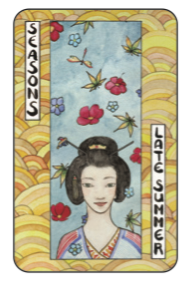
Earth element, season: late summer
In the late summer (Indian summer) there is enjoyment and gratitude for what has grown. Towards the autumn, what has come to full bloom in the summer is also harvested. The foods and fruits are collected and stored in granaries and pottery.
The earth element not only stands for the late summer season, but also for the transitional phases between the seasons. When yin and yang gradually alternate, earth maintains balance. The earth element thus monitors the changing periods of time, space and relationships. In the five element cycle, the earth element is therefore regularly placed in the middle, with the 4 other elements around it.
Metal element, season: autumn
The season of decay and loss. In the fall, the juices, the life force of each plant, withdraw from the leaves and branches. It is collected in the roots and nutrients maintain their strength underground during the long, cold winter.
In the opposite direction, the tree directs the impurities it no longer needs up to the leaves. In the approaching winter, these leaves no longer serve the tree, so they receive no nourishment and fall to the ground.
There is peace after the harvest (in farming communities) and time for reflection and adjustment. A slower pace. In urban communities, this is precisely the start of the academic year and an important commercial season; the tension and workload increase. So are flu epidemics and lung-related diseases. A question from Carola Beresford-Cooke, written in 1995: could these be avoided if we allowed ourselves to maintain a slower pace?
Water element, season: winter
Winter is a time of rest and recovery. It has the characteristics of absolute yin, such as long periods of darkness, ultimate silence and low temperatures. The trees slumber, hibernate, until the spring sun wakes them up again. The winter cold is inviting plants and animals to conserve their strength to be prepared for the tougher times of this season. Activity comes to a minimum and growth stops. Attention is paid to rest and recovery. Back to the seeds, the essence, the great potential