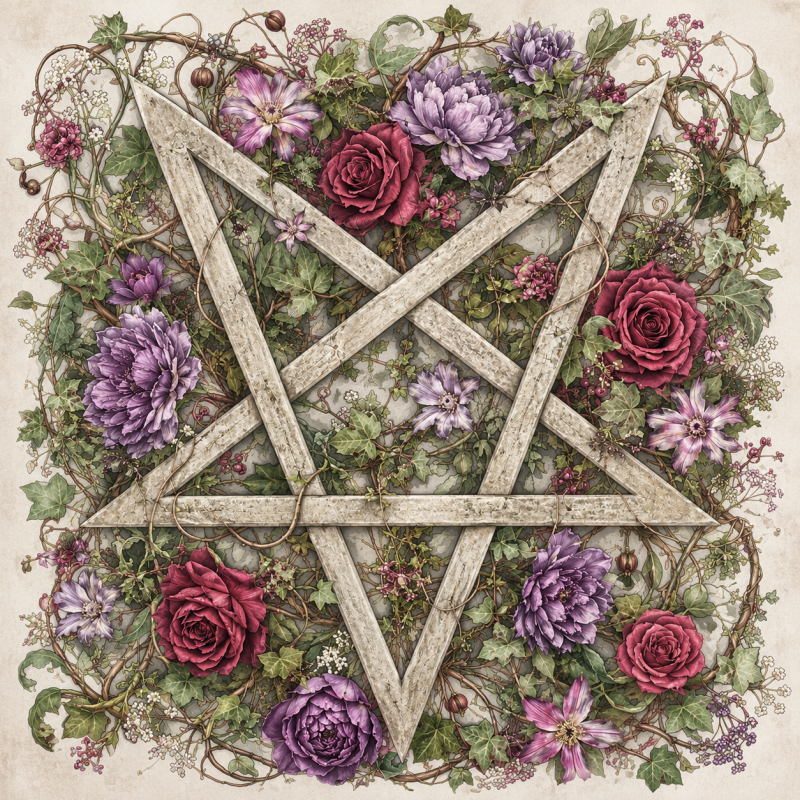
Unlock your inner power with The Altered Goddess's magickal toolbox
Dive into a world of spiritual exploration and practical enchantment. Our Magickal Toolbox is your guide to understanding and utilizing various tools and practices that can elevate your spiritual journey and enrich your daily life. Discover the power within you and how to harness it.
The pentacle is a five-pointed star enclosed within a circle, symbolizing the harmony of the five classical elements—earth, air, fire, water, and spirit—and is widely used as a protective and magical symbol in modern witchcraft and
Wicca
Definition and Distinction
The pentacle is typically represented as a pentagram (five-pointed star) surrounded by a circle. While the term "pentagram" refers solely to the star shape, the pentacle emphasizes the circle, which represents unity, wholeness, and protection. In practice, a pentacle can also refer to a physical object, such as a disc made of metal, wood, stone, or paper, inscribed with the pentagram or other magical symbols
Symbolism
Each of the five points of the pentacle corresponds to one of the classical elements:
- Earth – Strength, stability, grounding, and material concerns; generally the lower left point
- Water – Emotion, intuition, and the subconscious; lower right point
- Fire – Willpower, transformation, energy, and passion; upper right point
- Air – Intellect, communication, and knowledge; upper left point
- Spirit (Akasha or Ether) – The unifying force, representing consciousness or divine essence; the topmost point
The surrounding circle functions symbolically to contain the magical energy, ensure harmony among elements, and act as a protective barrier against negative influences
Historical Roots
The pentacle has origins in ancient Mesopotamia, where the pentagram represented celestial bodies and divinity. It was later adopted by the Pythagoreans in Greece as a symbol of the golden ratio and mathematical perfection
Inmedieval Europe, the pentagram was used in Christian symbolism to represent the five wounds of Christ and ward against evil
During the Renaissance, occultists like Heinrich Cornelius Agrippa associated it with magical practices, binding elemental spirits and providing mystical protection
Modern Usage in Witchcraft and Wicca
In contemporary Wicca and neo-paganism, the pentacle is used in rituals, spellwork, and personal protection. Common applications include:
- Protection – Acting as a talisman to repel negative entitites or energies
- Ritual Invocation – Calling upon the elements or spirits within a sacred space
- Focus and Spellwork – Concentrating intent and energies for manifestation, grounding, or magical empowerment
- Altar Tool – Consecrated pentacles on altars represent the element of Earth and serve as anchors for magical energy
The pentacle is also widely used in tarot, particularly in the Rider–Waite–Smith deck, where pentacles represent the element Earth, symbolizing material aspects like wealth, career, and physical health
Inverted and Misunderstood Meanings
An inverted pentacle, with two points facing upwards, is sometimes associated with Satanism or the left-hand path, but historically, orientations of the symbol had various interpretations where context and intention mattered more than inherent moral judgment
In most Wiccan and pagan practices, the upright pentacle symbolizes balance, spiritual integration, and protective energy.
Cultural and Artistic Significance
The pentacle has appeared in different cultures around the world, including the Serer religion of West Africa, Christian architecture, and ornamental designs in ancient Greece and Babylonia. Its geometric properties, including its relation to the golden ratio, highlight harmony and mathematical beauty observed in nature
. Modern art and jewelry often use the pentacle as a motif for personal empowerment, spiritual awareness, and ecological harmony
Modern Associations
The pentacle remains a central symbol in Wicca and neo-paganism. It is widely respected as a protective and positive symbol, although inverted versions have occasionally been misinterpreted in popular culture as sinister
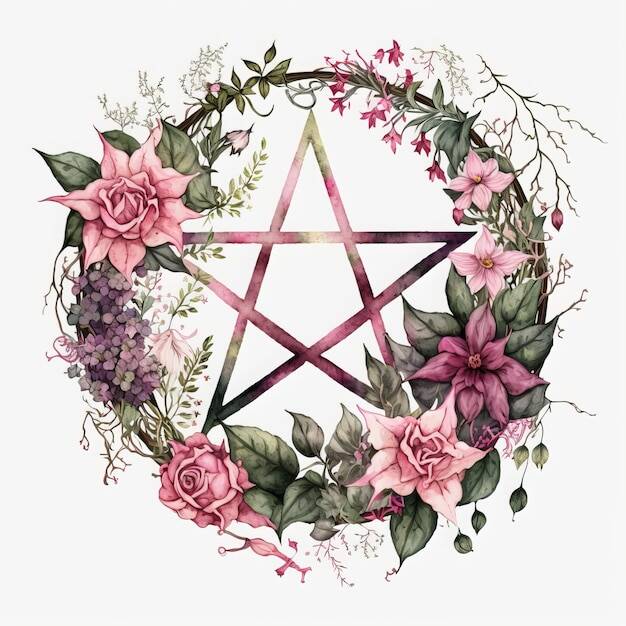
An upside-down pentagram is a five-pointed star inverted to symbolize the material world, rebellion, or occult practices, often associated with Satanism but not inherently evil.
Historical and Symbolic Context
The pentagram is a five-pointed star historically used across cultures for protection, magic, and spiritual symbolism. Upright, it represents spirit ruling over matter, harmony, and the five elements: earth, air, fire, water, and spirit
In contrast, an inverted pentagram has two points facing upward and one downward, symbolizing matter or physicality dominating spirit, a reversal of natural or spiritual order
This inversion has been interpreted as rebellion, human nature, or focus on the material world
Association with Satanism
The inverted pentagram became widely recognized in modern occultism through the Sigil of Baphomet, popularized by the Church of Satan in 1966. This symbol features a goat's head inside the inverted pentagram, with Hebrew letters spelling "Leviathan" at the points
Anton LaVey adapted this symbol as the Church's official insignia, associating it with iconoclastic philosophy and materialis
In popular culture and some Christian interpretations, the upside-down pentagram is often linked to evil, black magic, or Satanic worship
Broader Interpretations
Despite its associations, the upside-down pentagram is not inherently evil. In occult and Wiccan traditions, it can represent the descent of spirit into matter, the creative principle, or the shadow self
Its meaning depends heavily on context, intention, and tradition. In modern usage, it appears in music, fashion, and art as a symbol of rebellion, anti-conformism, or fascination with the occult.
Upright pentagram: Spirit over matter, protection, harmony, and spiritual growth.
Inverted pentagram: Matter over spirit, rebellion, material focus, or occult symbolism.
Modern associations: Satanism (Sigil of Baphomet), black magic, or countercultural identity.
Context-dependent: Can symbolize spiritual descent, shadow work, or creative transformation rather than evil
The upside-down pentagram is a complex symbol whose meaning varies across history, culture, and personal interpretation